Viktor Frankl

Anyone who spends time on Facebook knows all about those tests: “What European country are you?” “What decade are you,” “Which deceased female poet are you?” etc. Most of them are pretty unenlightening, not to say badly spelled (though I did admire the wisdom that correctly identified me as “Garden Party Barbie”) but today’s test, “Which psychotherapist are you?” reminded me of a name I hadn’t thought of in years. Evidently, I am Viktor Frankl, and I am a logotherapist.

Logotherapy, the therapeutic method developed by Frankl, teaches that human beings are primarily motivated by, not power or pleasure, but the desire to find meaning in their lives, and that we achieve peace when we find this meaning. We find meaning by doing a deed (work?), experiencing a value (truth, beauty, love; of nature, art, or a person), or, when all that is positive fails, through suffering.

If you have read my “About me” page, you will recognize that these are the views I share. Anyone who writes history is searching for meaning and is actively constructing it out of the chaos of data left by passing humans. Writing stories is a construction of meaning within the fiction/not fiction of the beginning, middle, and end of a tale. I don’t know if I believe that it is our primary impulse, but I believe it should be, that it is the only way to deal with the turmoil caused by all our other primary impulses.

I read Frankl’s Man’s Search for Meaning in high school, I believe in religion class at he Convent of the Sacred Heart. I was interested in anything to do with the Holocaust at the time, and I remember appreciating it, though not drawing any especially lasting lessons from it. At the time I did not know that my grandfather’s sister died at Theriesienstadt, where Frankl spent so much time or that, like him, my great-grandparents and my grandfather’s sister were transported to Auchwitz, though with worse fate. What I wonder now is how much Frankl’s book might have stuck inside me without me knowing it all these years. It seems that reading an account of the Holocaust is a rite of passage for high schoolers these days (rightly so). I also believe we are made up of all the books we have read, as well as the experiences we have had and the people we know. I wonder if I would have been different if we had read Primo Levi or Elie Wiesel or Anne Frank instead of Viktor Frankl at the Sacred Heart all those years ago?
In Praise of Historical Fiction

Those of you who like to read it or write it may be interested in this staunch defense of the genre by Sarah Dunant, in anticipation of the award of the first Walter Scott Prize for historical fiction:

Historical Fiction is the Genre of the Moment

I must say that I personally missed the moment when it was not a prominent genre, having moved straight from Jean Plaidy and Georgette Heyer, to Dorothy Dunnett and Colleen McCullough, and then on to Dunant herself along with her other peers without a break.
Why read historical fiction? Dunant defends the genre against the tiresome accusation of “escapism,” a charge that means nothing more than someone is enjoying their reading a little too much for some else’s taste, in my opinion. If we read to learn the truth of ourselves and our world, historical fiction will always have a place, because it is sometimes only by peering deep into the past that we can see ourselves truly, as if in Tuchman’s distant mirror.

By coincience, I finished Dunant’s Sacred Hearts this very evening. It was wonderful, and took me deep into the sixteenth-century convent world that I had explored earlier this year with my students in our class on Teresa of Avila. I can scarcely believe that 2010 has brought me such treasures already as it and Mantel’s Wolf Hall, also on the Scott prize shortlist. I don’t envy the judges.
And now I am off to read the rest of the shortlist

Summer Plans

Idea shamelessly stolen from Sarah Eve Kelly. I thought it would fun and maybe even useful to make a list of some of the things I hope to accomplish this summer as a way of keeping myself on track and honest. The original title of this post was ‘summer bucket list” but I realized once I was done that most of these things are not bucket list worthy (though some are). I am confining the list to those things over which I have some degree of control…

First are some things that are work related, but don’t feel sorry for me. I actually find working on my own research projects fun (which is why I have the job I have):

  • Finish and submit at least two articles for publication. They’re both nearly ready to go and there is no excuse not to get them out there.
  • Write another article on Cluny and Spain.
  • Write a paper presentation and article on Rodrigo Jimenez de Rada and Islam
  • Decide whether I want to spend a good deal of time working on Michael Scot and not feel guilty if the answer to that question is “no.”
  • Figure out what I want to write next.
  • Okay, now here are the fun bits:

  • Visit Kelmscott
  • Do “some” or maybe even “most” of the long walks around Oxford that I have printed out
  • Lose ten pounds. Okay maybe that won’t be “fun” all by itself But if I do it by walking (see above) then it will be pretty fun.
  • See my sister and my cousins.
  • Eat at Moro and Ottolenghi
  • Visit North Hatley, maybe in time for the Ayer’s Cliff Fair this year.
  • And last but not least, meet Sarah herself!
  • What are you trying to accomplish?

    Under the Volcano

    Stuck in Heathrow/Schiphol/La Guardia/Charles de Gaulle? Finished your Grisham and your George and need some new reading material? I’ve got the perfect selection of novels you can read to while away the time.

    My first choice is Margaret Elphinstone’s Hy Brasil. This is one of my favourite novels of all time, and it is the perfect thing to distract you from airport food. The story of Sydney Redruth’s visit as a travel writer under false pretenses to the imaginary island of Hy Brasil, a place that combines elements of Bermuda, Newfoundland, the Faroes, and yes, Iceland, located somewhere in the north Atlantic, it includes pirates (yes), ancient treasure, love, drug smuggling, political corruption, and indeed, a great big erupting volcano. You won’t be able to put it down.

    While you’re in the Elphinstone section of the airport bookstore, check out her The Sea Road, a novel about a woman of Iceland who travels with the Vikings to the coast of Newfoundland. Not only will it pass the time, it will give you some ideas about possible alternate routes and methods for crossing the Atlantic while your airplane is stuck on the ground.

    If it is more volcanoes you want, I suggest, Dorothy Dunnett’s To Lie with Lions, which has the benefit of still being in print. I won’t give away the plot, except to say that it has a fabulous climax during a fifteenth-century explosion of Mount Hekla, in Iceland. It is the sixth book of an eight book series though, so you’d be best off starting the series with book one, and reading through. Don’t worry. You’ve got time.

    80’s shoes

    Check it out:

    angrychicken.typepad.com

    I found this post the usual way by following a link that took me to a link and then to another, but this one stopped me cold.  Dear Reader, I owned almost every single pair of these shoes.  Not the Tretorns.  My sister owned the Tretorns.  But Duck boots? Check.  Jellies? Check?  Penny loafers (no pennies; that’s TTFW), topsiders, espadrilles?  Check, check, check.  I even owned a series of pairs of Dr. Scholl’s.  In fact, I still have the last pair and I wear them at the cottage.  God, I was such a  preppy.

    I haven’t felt so bad since I realized my local Whole Foods plays the soundtrack of every high school dance I ever attended every time I shop there.  I’d better stay away from Urban Outfitters or it could get ugly.

    My Keds were pink, by the way.  And this is not an Aril Fool’s joke.  I only wish.

    Medieval Academy at Yale

    I got back a couple of days ago from the annual conference of the Medieval Academy at Yale. I have to admit, it is a conference I usually avoid for a variety of reasons, mostly having to do with an unedifying reverse snobbery. I was persuaded to attend this year by a worthy cause, a session organized to honour my beloved doctoral advisor. “Oh well,” I thought, “It is worth it for that alone and I can spend the rest of the time reading novels and eating fish by the seaside.”

    I did eat fish by the seaside (lobster rolls, lobster bisque, and sole in lobster sauce in one memorable meal), but the conference was worth it on so many levels. It was beautifully organized. Conferences, like armies, march on their stomachs and we were exceptionally well treated in that respect. The program was really exciting, and this is not always the case, to put it mildly. So, good for you, Yale.

    Spotted this Morning

    In Publisher’s Marketplace:

    Dutch rights to Alison Pick’s THURSDAY’S CHILD, to Orlando, at auction, by Margaret Halton at Rogers, Coleridge & White, on behalf of Anne McDermid at Anne McDermid & Associates.

    Congratulations, Alison!

    Me and the Pope

    I’m pointing you outside my blog today, to a post I wrote for the web journal Sightings, published by the Martin Marty Center. As many of you know, I wrote my dissertation and first book on anti-Jewish religious polemic in the Middle Ages, and the way it was used to define Christians and separate them from those with different beliefs. When I read the address Pope Benedict XVI gave at Regensburg on reason and faith in 2006, it upset me greatly because I had the sense he was arguing for a return to twelfth-century modes of inter-religious understanding — or misunderstanding as it might be. But I wasn’t moved to write until a couple of weeks ago, when I read a new address he gave praising one of the architects of this understanding, Peter the Venerable. Here’s the first paragraph, and the link that follows will take you to the full text:

    n his general audience in St. Peter’s Square on October 14th, Pope Benedict gave an address in which he held up the twelfth-century monk and abbot of Cluny, Peter the Venerable, as a model for contemporary Christians, lay and monastic, praising him for his ability to balance both contemplative spirituality and the demands and pressures of the world. Peter was an unusual choice. Though the pope associated him with the abbey’s canonized abbots, quoting his papal predecessor Gregory VII that at Cluny, “there was not a single abbot who was not a saint,” Peter in fact was never canonized. Why select him as a model over other Benedictine contemplative administrators, not least Saint Benedict himself, who could provide the same example of tranquility in the face of turmoil? What makes Peter stand out from his brethren at this moment in time?

    http://divinity.uchicago.edu/martycenter/publications/sightings/archive_2009/1029.shtml

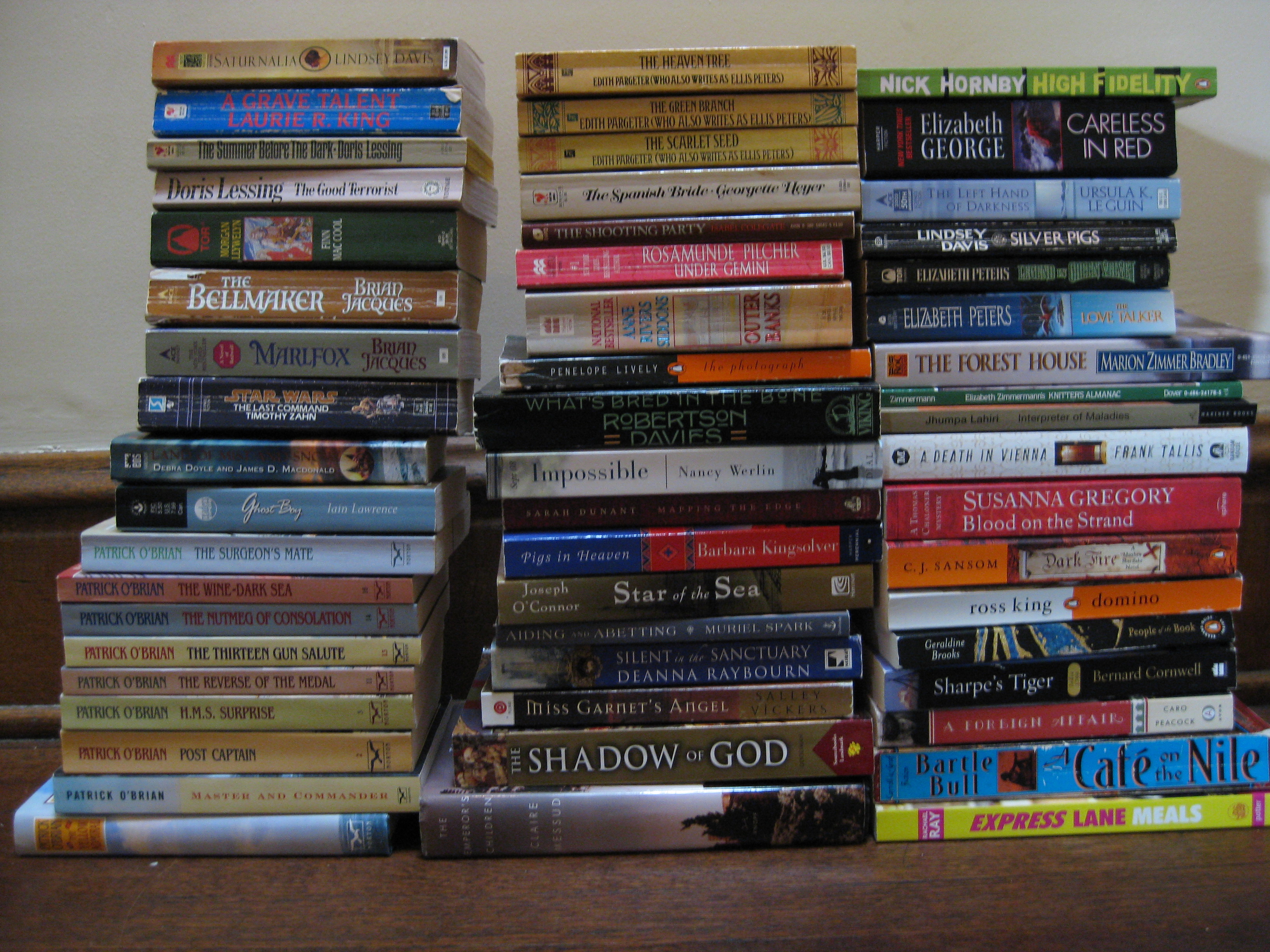
    Hyde Park Booksale

    booksale2009
    As promised, here’s a photo of my treasures from the annual Hyde Park used booksale. Missing from the photo are a couple of gifts, but otherwise, they’re all here, 50 books for around $30. Taking a look at my piles, I can see why I have a hard time answering “What’s your favourite genre?” questions. I truly do read a little of everything. But they’re not all mine. Most of the left-hand stack are for my son, especially all the Patrick O’Brians. And the Star Wars. But you knew that.

    (Click the photo for a larger view)

    Michael and Farrah

    I felt like the last part of my childhood died today.

    I know a lot of people have said that by now, but that’s because sometimes a cliche is true. To my son, Michael Jackson is nothing more than a set up line in a joke about pedophilia, but like so many others, I grew up with him. For me, he was in the background, not centre stage, but always present, from the Saturday morning cartoon show to the explosion of “Off the Wall” — which made a much greater impact on me than “Thriller.” I’ve always loved his dancing more than his music, though some of his songs are still iconic for me. “Billie Jean” was high school graduation. I still have an old cassette tape somewhere that has Yaz’s first album on the A side and then Altered Images, ABC “The Look of Love,” Men Without Hats “Safety Dance,” and “Billie Jean” on the flip side.

    My relationship with Farrah is far more complicated. She hit on the very cusp of my homely adolescence and what that poster said to me and to a generation of young women was, “You will never, ever be good enough. You will never be who someone wants.” When we played “Charlie’s Angels” in the playground, I knew instinctively that the most I could attempt was Kate. And that’s sad, because, given her choice of roles in later life, intimidating a crowd of teenage girls was probably the last thing Farrah ever wanted to do.

    I think this video is as good as any to close with because it shows Michael at one of his most admirable moments, and also encapsulates the era I’m saying goodbye to as well as anything could.