I was delighted to be asked to present the lecture in Medieval Studies for this year, and to be able to use it as an opportunity to present new work on the earliest Latin Maimonides. Many thanks to Henrike Lähnemann, Mark Williams, and Oxford Medieval Studies for inviting me. Although the internet failed us at the time, I was able to have a version of the lecture recorded to share here.
And don’t miss the trumpet fanfare and lovely introduction by Henrike that we caught before the wireless failed:
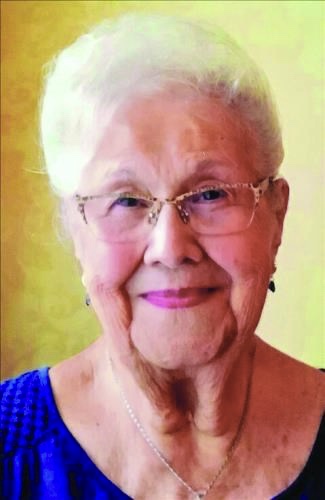
We visited Gloria in late September 2019 in her apartment in a senior living complex in Pittsburgh with a view of the Allegheny River. At the time, I had a strong sense that I was seeing her for the very last time. Without Covid, that probably wouldn’t have been true, but as it happened, I was right, and I think maybe she knew it too. We talked about the Democratic primary and how she liked Pete Buttigieg, we ordered Chinese food, which took a long time to arrive, and mostly we listened to an old recording made at her parents’ sixtieth anniversary that reunited her with her siblings, singing and playing all the old standards from the 30s and 40s. Beautiful music.
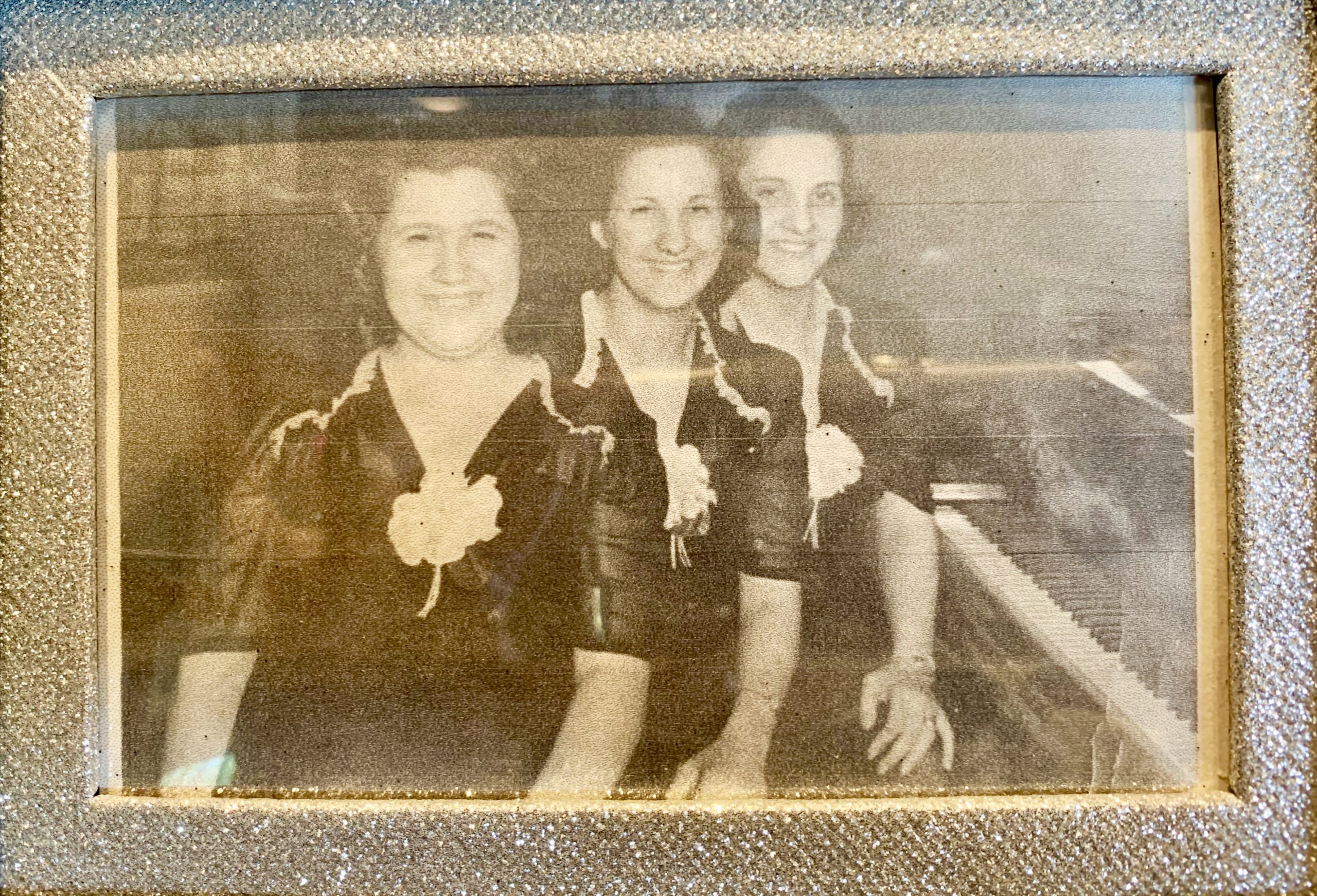
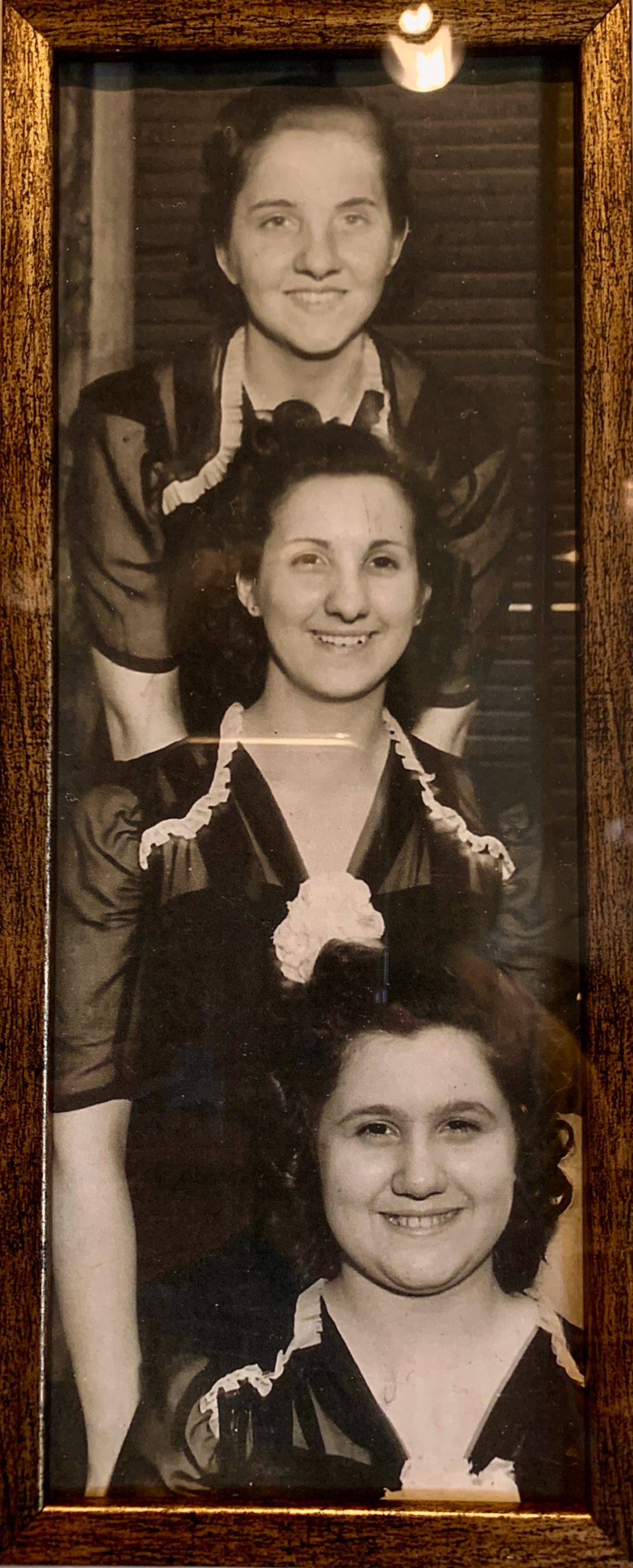
Before she was eleven years old, Gloria started singing with her sisters, Tess and Mary, six and eight years older than she. Gloria sang the lead, rewriting the music so it suited her alto voice, while her sisters sang harmony above and below her, their voices melting together in a way you only hear when families sing together. You can see Gloria in front here with her two sisters behind, Tess then Mary. It wasn’t long before they won the $200 first prize in Wilkins’ Amateur Hour on Pittsburgh’s WJAS radio station, under the name “The Dattilo Sisters Harmony Trio”.
But not long after that, the group broke up for a time, when Mary ran away with a man, “much older” than her — a “criminal.” Two years later she was back, with a small son, and the music continued.
It was not an easy life. Gloria’s parents emigrated from Calabria, her father Vincenzo first, rechristened James at Ellis Island, and then her mother, Carolina, the only woman in steerage with two small children. She refused to ever cross that ocean again. Carolina gave birth to ten children, seven of whom survived to adulthood. Gloria was the last, the baby, and in many ways, it seems she got the best of her mother, as last children in large families sometimes do. They lived in the Hill District of Pittsburgh, not far from where August Wilson was growing up at the same time. They owned a little shop, and Gloria would take the incline down the hill with her mother to the Strip District to buy live chickens and vegetables to sell. Carolina crocheted an afghan from yarn found floating down the river during the Pittsburgh Flood of 1936, that still lies on a bed upstairs at our house. Carolina had little use for the Church.
It’s a life I find hard to imagine, but it was one whose contours were shared by millions of immigrants across the United States. One thing that lasts from that life is the food. My husband, who was married before her death to Angela, Gloria’s beloved only child, describes the meal they ate at Thanksgiving the first time he went down to be with her family. It began with antipasti of every kind on a kind of etagere, then progressed through Italian wedding soup before he was served ravioli so wonderful he had to have a second helping. And then. And then. They brought out a full American thanksgiving: turkey, mashed potatoes, vegetables, gravy, pies…
The girls, now renamed The Three Ds, did sing again, on “Buddy Murphy’s Guest Book,” on radio station KQV, and rebroadcast up and down the eastern seaboard. There was talk of more, of trying to make it in New York City after the war, but Carolina put her foot down. Tess got married, and that was the end.
Carolina was not allowed to get an education, but she made sure Gloria graduated high school at age fifteen, and then from the University of Pittsburgh with a degree in Psychology and Sociology. Later, Gloria added an MA in Social Work. For twenty-five years, she directed a residential centre for troubled youths in Waynesburg PA. The first time I met her, at a party, she spoke of how experience with those children shaped her generous views of those who fall through the cracks and need compassion and support. Gloria was an Italian-American, a Catholic, a liberal, and a Democrat.
As we sat and talked with her that last afternoon, listening to her sing in the recording of her family, my eye was drawn to the legend written on a plaque on the wall. It was a quotation from Erma Bombeck and it read, “When I stand before God at the end of my life I would hope that I would have not a single bit of talent left and could say, ‘I used everything you gave me.'” In wonderment I realized that yes, yes she had. She offered up everything of herself she had ever been given. She gave all of herself. And I have no doubt that what she gave will be received.
So now sit back, relax, shut your eyes and please listen once more to the harmony of The Three Ds, led by Gloria Gugliotta:
I’m delighted to post an interview with Tinney Heath about her most recent novel, Lady of the Seven Suns, about the Roman laywoman Giacoma di Settesoli and her relationship with Saint Francis of Assisi. Tinney has a background in journalism and a passion for medieval Italy. She is the author of several previous novels, including the recently re-released A Thing Done. You can learn more about her books, and join her newsletter at her webpage: https://tinneyheath.com
You set most of your writing in Italy. How did you come to write about Italy, and how did you come to be interested in the period before the plague when so many Italophiles focus on the 15th and 16th centuries?
It probably started when I was a teenager obsessed with Italian opera. I learned to speak operatic Italian, but I quickly realized it wasn’t going to do me much good, either for research or for travel. So in time I picked up some more practical Italian and finally made my way across the pond to Florence, and then I was hooked.
To my surprise, it wasn’t the High Renaissance of Michelangelo and the Medici that most fascinated me, but an earlier Italy, that of Dante and before. There was something alarmingly familiar in those constantly squabbling Guelfs and Ghibellines, battling each other in the streets of cities whose skylines bristled with forbidding stone towers.
Dante’s contemporaries and immediate forebears occupied a world unlike ours in many ways, and yet ours seems to be witnessing an upsurge in many of the same challenges they faced: drought, flood, famine, fire, epidemics, extremes of heat and cold, scarcity and want. And conflict. Always, conflict. Strife and contention, opposing factions jockeying for power. Fear and hatred, resentment and misunderstanding, xenophobia. Vilifying one’s opponents. Polarization. There is a certain immediacy in watching a long-ago society try to deal with these challenges, because we have only to look around us to see that despite our technology and our supposed advancement, it is all still happening. Perhaps there’s some hope in the fact they must have gotten through it somehow, or we wouldn’t be here.
You chose to show us Francis and Clare through the eyes of a third person, Giacoma di Settesoli. What drew you to her as a character, what do you think her perspective offers readers, and why have so few people ever heard of her?
I learned of Giacoma’s existence by chance, shortly before a planned vacation trip to Assisi. I was intrigued by the idea that a powerful, wealthy widow with strong political connections and control over a great deal of property could somehow become fast friends with the barefoot holy man who was devoted to Holy Poverty.
Giacoma remained a laywoman, uncloistered, able (thanks to her wealth, family status, and widowhood) to move freely around Rome and Assisi, largely unhampered by societal restraints that would have restricted her point of view. More than one contemporary account says that Francesco called her “Brother” and alludes to her close friendship with Francesco and with his other early followers.
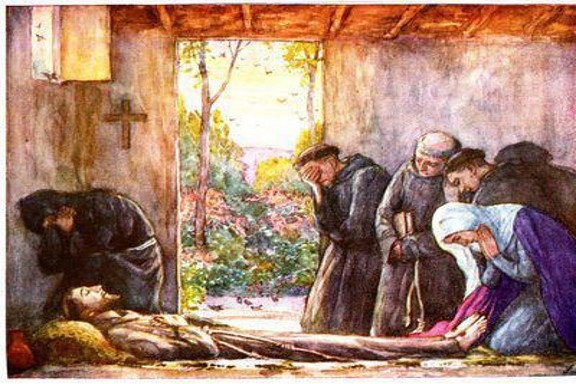
Giacoma at Francesco’s deathbed by Chilean artist Pedro Subercaseaux Errázuris, OSB (1911-1920s)
Francesco’s friendship with Giacoma is all the more surprising because he was so cautious about dealings with women. He wrote, “Let all brothers avoid evil glances and association with women. No one may counsel them, travel alone with them or eat of the same dish with them.” And yet this is the man who, on his deathbed, instructed his brothers that the prohibition on women entering the brothers’ compound need not be observed for her.
Why have so few people heard of Giacoma? Some scholars say that her obscurity comes from the 13th century Church’s reluctance to allow Francesco’s friendship with a woman to become part of the official record. Not wanting to sanction holy men fraternizing with women, the ecclesiastical authorities chose instead to ignore Giacoma as much as possible.
In the first two Church-mandated biographies of Francesco, written by Francesco’s contemporary Thomas of Celano, Giacoma is not mentioned at all. In Saint Bonaventure’s biography, written a few years later, her role is downgraded and the story of her presence at Francesco’s death is omitted. Historian Jacques Dalarun suggests that Bonaventure “exalted Clare, the cloistered nun, over Giacoma, the lay aristocrat, in having a special spiritual rapport with Francis.”
It wasn’t possible to expunge Giacoma from the record completely. We have writings from Brother Leo and others of Francesco’s earliest followers, and they talk freely about Giacoma, just as they talk about all the others who were part of Francesco’s life and brotherhood. The best the Church could do was to de-emphasize her, and that it did.
When officialdom couldn’t omit Giacoma entirely, it tried instead to emphasize the miraculous aspects of her story, thus leaving Francesco free of any suspicion. Her presence at his deathbed is a miracle because it was God who told her to go to Assisi; she was like the Magi because she brought gifts; and she was another Mary Magdalene because she mourned over Francesco’s body.
Francis and Clare are saints in the Catholic Church, and Giacoma herself is a “Blessed” — in fact (as I learned from you) her feast day is tomorrow. What were the challenges of writing a novel with broad appeal about important figures in a specific religious tradition?
Everyone has an idea of who Francesco was. To some he’s the gentle, loving patron of animals; to others, a simple man who wanted to follow in Christ’s footsteps and who was blessed with the stigmata. Many people, when asked, will start quoting from the so-called Prayer of Saint Francis (“Lord, make me an instrument of Thy peace…”), not realizing that this anonymous prayer appeared for the first time in the early 20th century in a French magazine. People of all faiths and of none revere Francesco, but most of them know very little about the times in which he lived or even about his personal history, which is more complex than all the sweetly-smiling statues suggest.
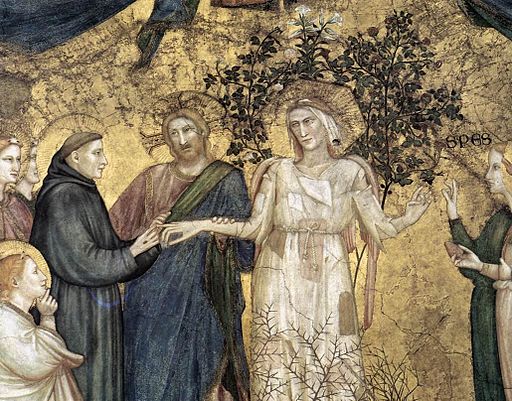
Francis Wedding Lady Poverty, by Giotto
That does make it a challenge to try to depict him in fiction without offending, so I simply wrote him the way I saw him – an extraordinary man, utterly original, midwifing (sometimes reluctantly) a religious movement that had to be constantly safeguarded from any hint of heresy. I am not Catholic myself, which probably made for a steeper learning curve when writing about 13th century religion. On the other hand, it prevented me from assuming that aspects of modern Catholicism applied to the church of Francesco’s time, which was not necessarily the case.
Are there any favorite stories about your characters that you weren’t able to work into the novel?
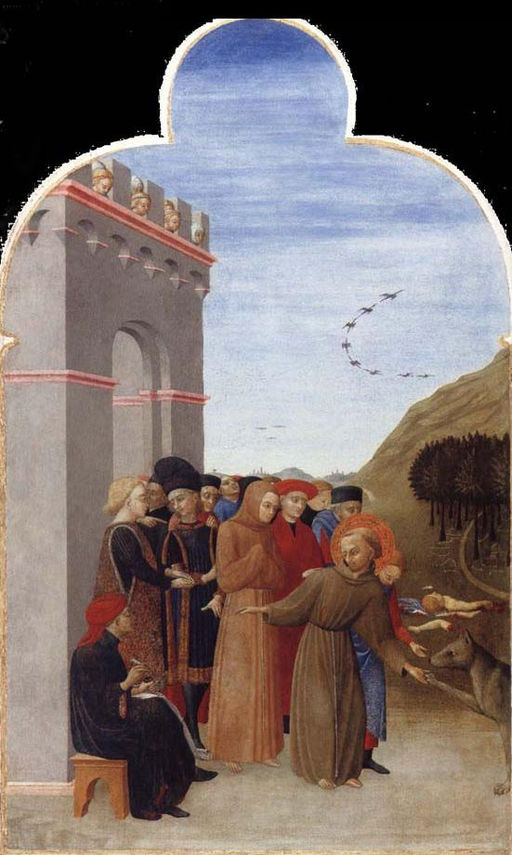
Yes, many. For instance, there’s the story about Francesco and the wolf, in which he charms, tames, subdues, converts, befriends, and negotiates with the ravening wolf that had been terrorizing the citizens of Gubbio. He does everything but enroll it in a twelve-step program, and by the time he’s done, the townspeople have agreed to feed it and let it live in Gubbio, and the wolf, by placing its paw in Francesco’s hand, has agreed to stop killing people and their animals. (Some say the “wolf” was actually a human outlaw harrying the city.)
Francis and the Wolf, by Sassetta
There’s a delightful painting by Sassetta in London’s National Gallery showing Francesco, the wolf, the people of Gubbio, and a seated notary scribbling away at their contract. Nothing could be more quintessentially Italian and medieval than that notary, who is no doubt trying to figure out how he’s going to obtain the wolf’s signature.
The other story I would love to have included was the rather bizarre turn Brother Elias’s life took after Francesco’s death, but my timeframe wouldn’t permit it. He somehow managed to go from being Francesco’s trusted Vicar General to the person entrusted with building the lavish Basilica to house Francesco’s relics (against the wishes of some of the earliest brothers), and from there to polarizing the order, serving as papal ambassador to Emperor Frederick II, getting excommunicated and thrown out of the order, and just to cap it off, riding into battle at the side of Frederick II. It’s said that children playing in the streets used to chant, “Frate Elia has gone astray, he has chosen the evil way.” (At least, that’s what they would have chanted in Guelf territory.)
Elias’s whole unlikely trajectory is fascinating and would make a wonderful novel. I’m not going to write it, but if somebody else does, I’ll definitely read it.
Thank you, Tinney! So would I!And I am looking forward to more books from you.
I was delighted to be interviewed by Kristen Geaman about my book recently for the Royal Studies Journal blog. You can read the interview and a review of my book here.
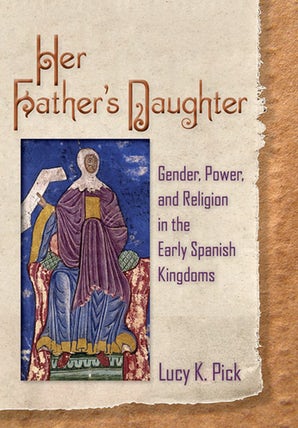
I am thrilled by the interest the Royal Studes Journal has shown in Her Father’s Daughter. My argument in the book is that the female royal power I was seeing was not a consequence of personality or chance historical circumstances, but was rather part of the structure of how power was organized. When I was working on the book, I wanted to write it in such a way that it would be useful as a possible model for people thinking about gender and power in places and periods very different from medieval Spain. The Royal Studies Journal has helped me greatly to reach some of that audience.
Medieval historians need to do a better job of talking about race.
I’ve been thinking about this for a while now, at least since last January when I attended a panel on race in medieval European history at the AHA and was part of another panel on “relevance” in the study of the Middle Ages and Early Modern Europe down the street at the MLA. I’ve been thinking about it in a more systematic fashion over the last few months as the Lexicon Project — a group of faculty and students at the University of Chicago who gathered initially to talk about the lexicography of sexuality and gender — has expanded its focus and its community this quarter to discuss race, and as a goad to our discussion, we’ve been reading a range of scholarship in the area.
I have also been thinking about it because instead of working on hagiography and dialogue and nuns, as I thought I’d been doing now, my attention has been called back to the project I began my career as a medievalist with, back to the thirteenth-century archbishop of Toledo, Rodrigo Jiménez de Rada and relations between Christians, Muslims, and Jews. I’m working on two things at the moment — an article on Jiménez de Rada’s globalism, and a longer piece on Jewish and Christian intellectual exchange and competition.
Working on the article has made me realize what an awful lot of evidence historians of medieval Spain have left on the ground, evidence that could be used for a rich and fruitful discussion of race in the Middle Ages. Working on the other project has returned me to something I observed in my first book, Conflict and Coexistence: Archbishop Rodrigo and the Muslims and Jews of Medieval Spain, about the difference between the contemporary historiography of medieval Christian-Jewish relations and the historiography of medieval Christian-Muslim relations. As I wrote in 2004:
“The perceived breakdown in harmony between Jews and Christians is perceived as a puzzle, as a problem, and different factors are adduced by scholars to explain this perplexing state of affairs. By contrast, conflict in relations between Christians and Muslims is taken for granted and seems to need no explanation.”
At the time, the model of difference I was using was that of alterity, inspired somewhat by David Tracy’s Dialogue with the Other and Julia Kristeva’s Strangers to Ourselves. I think now that race might have been a more effective and sharper tool for understanding the difference between those two historiographies. Put simply, most of us who study Christian-Jewish relations in medieval Iberia are Jews of one kind or another. We’re of an age that we grew up, one way or another, in the long shadow of the Nazi racialist project. The one thing, perhaps, that unites us is that we know we do not want to be a race. We know what happens when Jews become a race. We’re just like you! we say. We’re white! We’re European/American/Canadian! It’s weird that you guys did all those awful things to us but we’re willing to let bygones be bygones if you let us into your universities! And we’ve been very leery of allowing race to be one of our categories of analysis for interpreting the Middle Ages, and we pretzel ourselves into knots trying to avoid it, as the news mounts up from the Tree of Life, from desecrated cemeteries, from Twitter and 8chan, that a race is not something you choose for yourself; it is something others ascribe to you.
And into this historical moment comes Geraldine Heng’s The Invention of Race in the European Middle Ages. I remember the man who became my doctoral advisor, Jocelyn Hillgarth, lamenting in the very first session of the very first class I took with him that no one wrote big books any more, no one took risks or made big arguments. This is a big book. And what it offers us is a way to cut through the anxiety medieval historians have felt about speaking of race in the Middle Ages — fears of anachronism, fears of a teleology that begins with us, obsession with biology, with vocabulary, with colour, with DNA, all these things that have made us wishy-washy and hesitant.
Race has no substantive content, Heng says. Race has no substantive content. Rather, it is “one of the primary names we have — a name we retain for the strategic, epistemological, and political commitments it recognizes –that is attached to a repeating tendency, of the greatest import to demarcate human beings through differences among humans that are selectively essentialized as absolute and fundamental in order to distribute positions and powers differentially to human groups.”(p. 3, 27) I’ll emphasize some of words I think are key in this formulation: Race is a name. The phenomena it describes are repeating and grave. It demarcates differences that are essentialized as foundational. These differences are used as the basis for differential distributions of power.
Race is not a single “thing.” It is a structural relationship for the articulation and management of human differences.” (p.3, 27) And it is one of the factors that creates the European subject.
This is not a review of Heng’s book. For one thing, I haven’t finished reading it. I’m sure there are places where I will disagree with this interpretation or that — I can already see a few spots where my own argument would be different. That’s not the point. I don’t take this as the last word. I take it rather as an invitation do further work, and as a gift of a powerful tool that we can use for understanding when differences that are religious or ethnic or physical or gendered become racialized (and when they don’t or haven’t and how this changes or doesn’t over time). Talking about race in the Middle Ages is not going to be about finding a particular word used, or a physiognomy described, though those may be the clues we use as evidence. Each case has to be argued on its own merits. We will disagree.
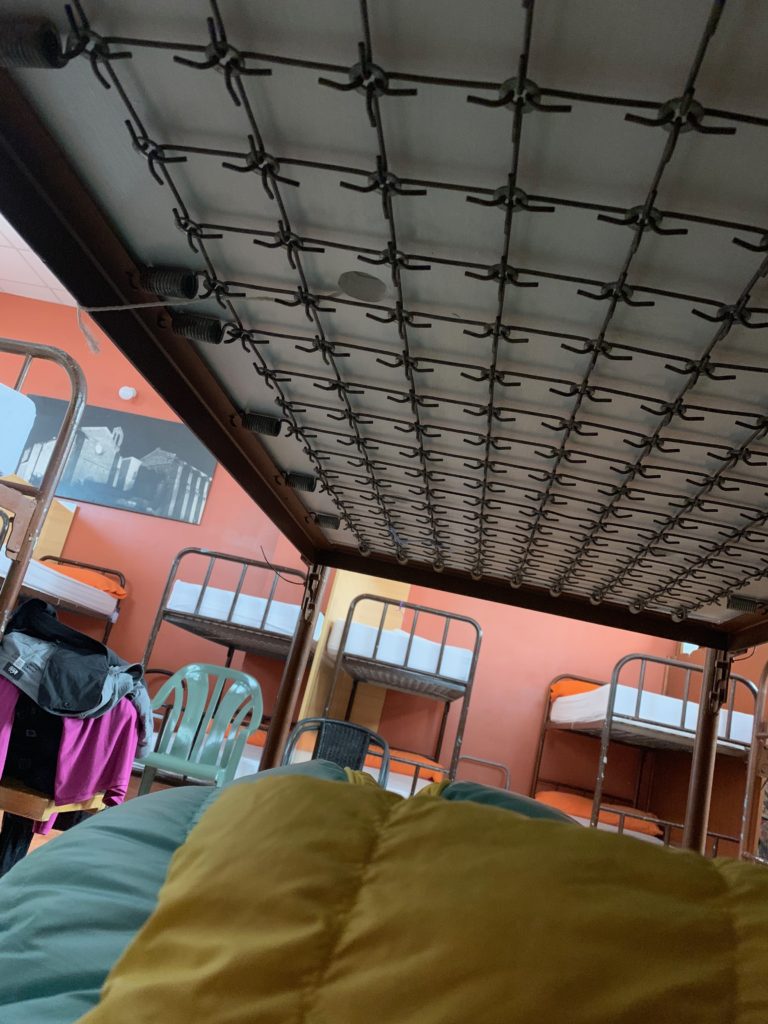
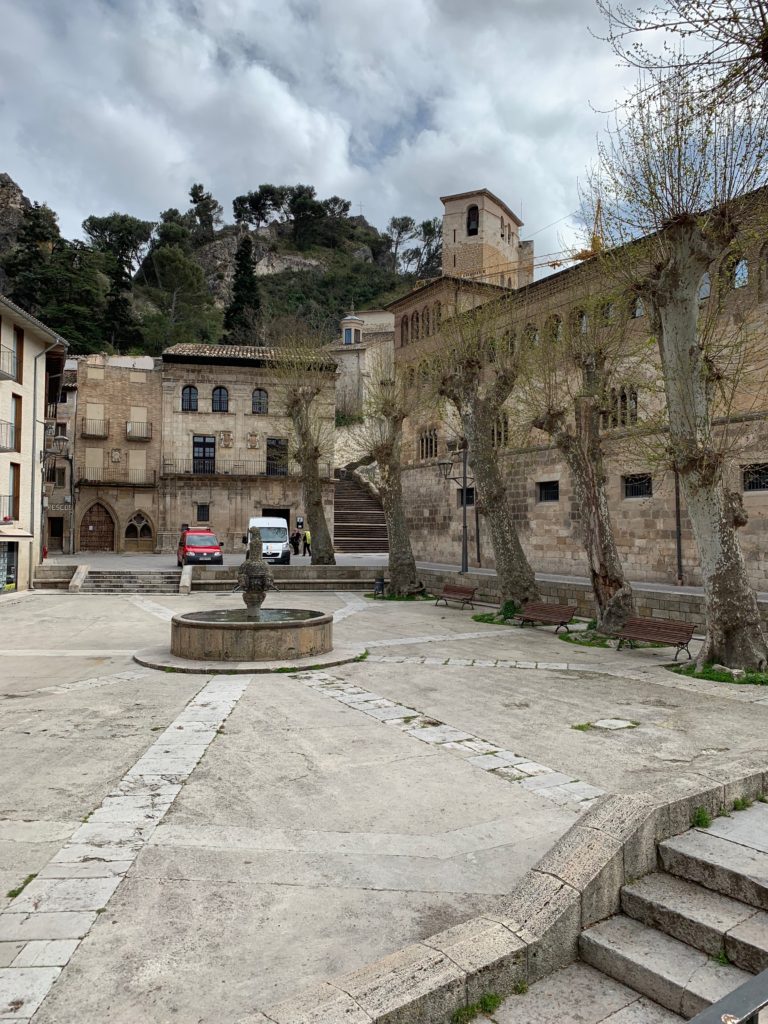
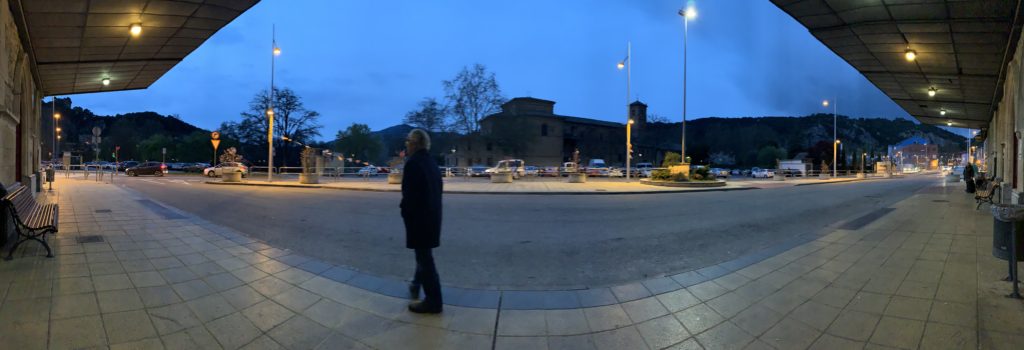
It was lucky and maybe surprising that I liked Estella so much, given that this was my view of it for most of the time I was there:
But Estella is lovely. Imagine the shell of a soft boiled egg once you’ve knocked the top off, leaving the sides jagged and craggy, and after you’ve eaten the egg out of it. Now imagine a town nestled in the bottom of the shell, with a river twisting through it.
In the Middle Ages, there were castles on many of these hills, protecting the town, which was founded in 1090 by King Sancho Ram irez of Navarre by annexing the fortified Basque settlement of Lizarra. The king’s plan was to move the main road, which is also the pilgrimage road to Compostela, out of the difficult hills above, so it could run more easily down through the flat. He encouraged settlers from France and also Jews to come live there, and they did, settling in what became three adjacent walled communities, and creating an important trading hub.
I got a strong sense of that medieval city, especially on the side of the river where my albergue was, right on the pilgrimage road, underneath the old Jewish quarter, pressed up against the hill. In the photo above, the Camino is the street that runs behind those two cars. The ground floors of many of the buildings that run along it are very old, even medieval, as you can see from the two behind those cars. To the right is the palace of the Navarrese kings, whose first floor dates to the late twelfth century, a rare example of civic Romanesque architecture. More on that soon. In the background to the right, the tall tower you can see belongs to the church of San Pedro de la Rua. Above it, on the hill, was one of the castles I mentioned, and when it was destroyed by the Castilians in 1572 in their war against Navarre, it fell on the twelfth-century cloister of the church, destroying half of it. I wasn’t able to get into the church or cloister (hello, Spain, and churches that are not open when they say they will be) but I did use some of my strength to climb the many steps up to the facade. It was worth it.
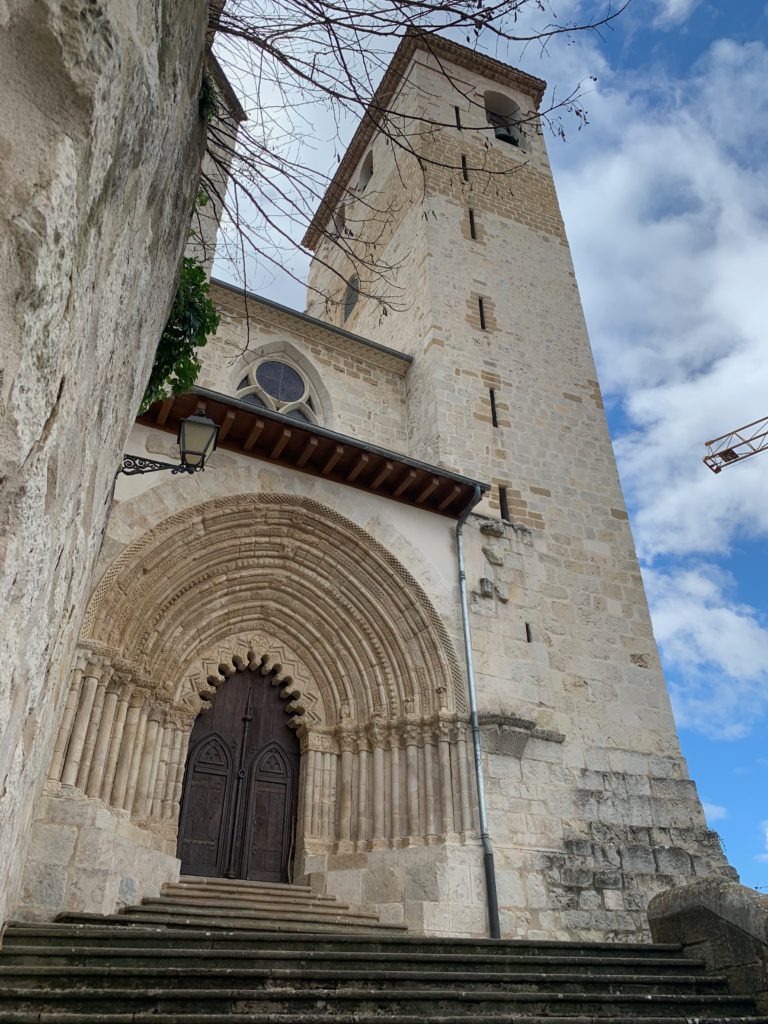
You can see it is as much fortress as church. Estella has been on one frontier or another during most of its existence, most recently in the nineteenth century, during the Carlist Wars.
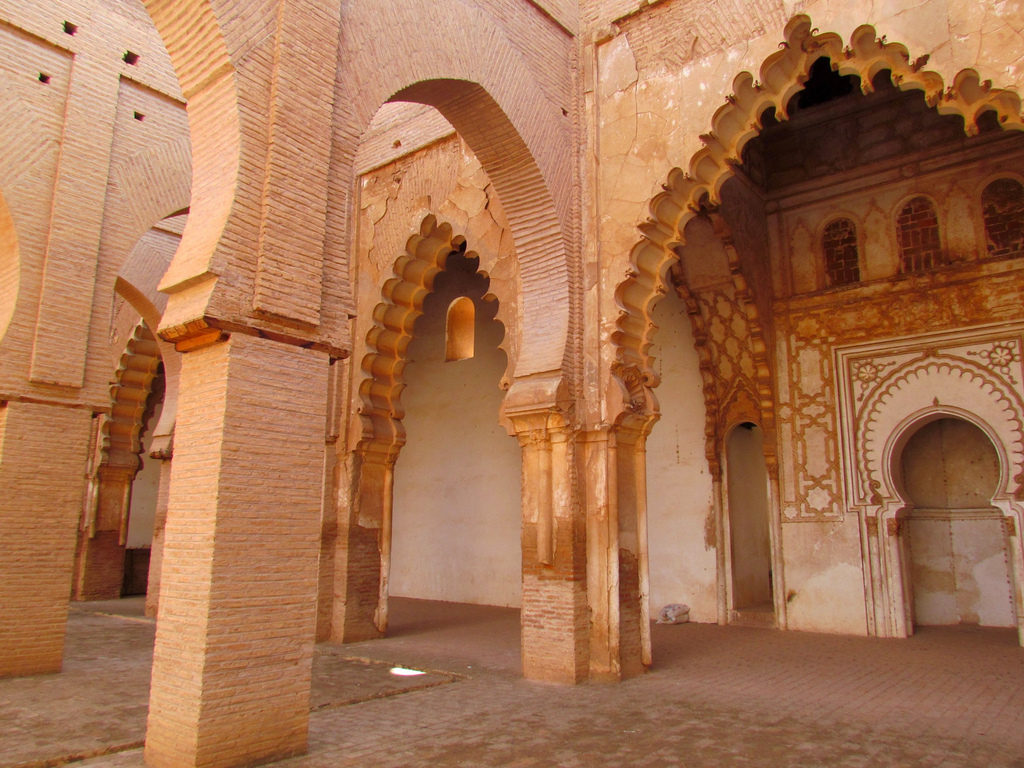
I think when most of us look at a building like this, we think things like “Gothic” “French” “European”. Maybe that polylobed arch gives some of us pause. Pilgrims will have seen one very like it walking through Cirauqui earlier that day, but others might think more of buildings that look like this:
This is the Tin Mal mosque, in Morocco, built to commemorate the Almohad leader Ibn Tumart in 1156, four years before Notre Dame was started in Paris and a few decades before San Pedro de la Rua was constructed. The Almohad Empire extended from Africa through the southern half of Spain at this time.
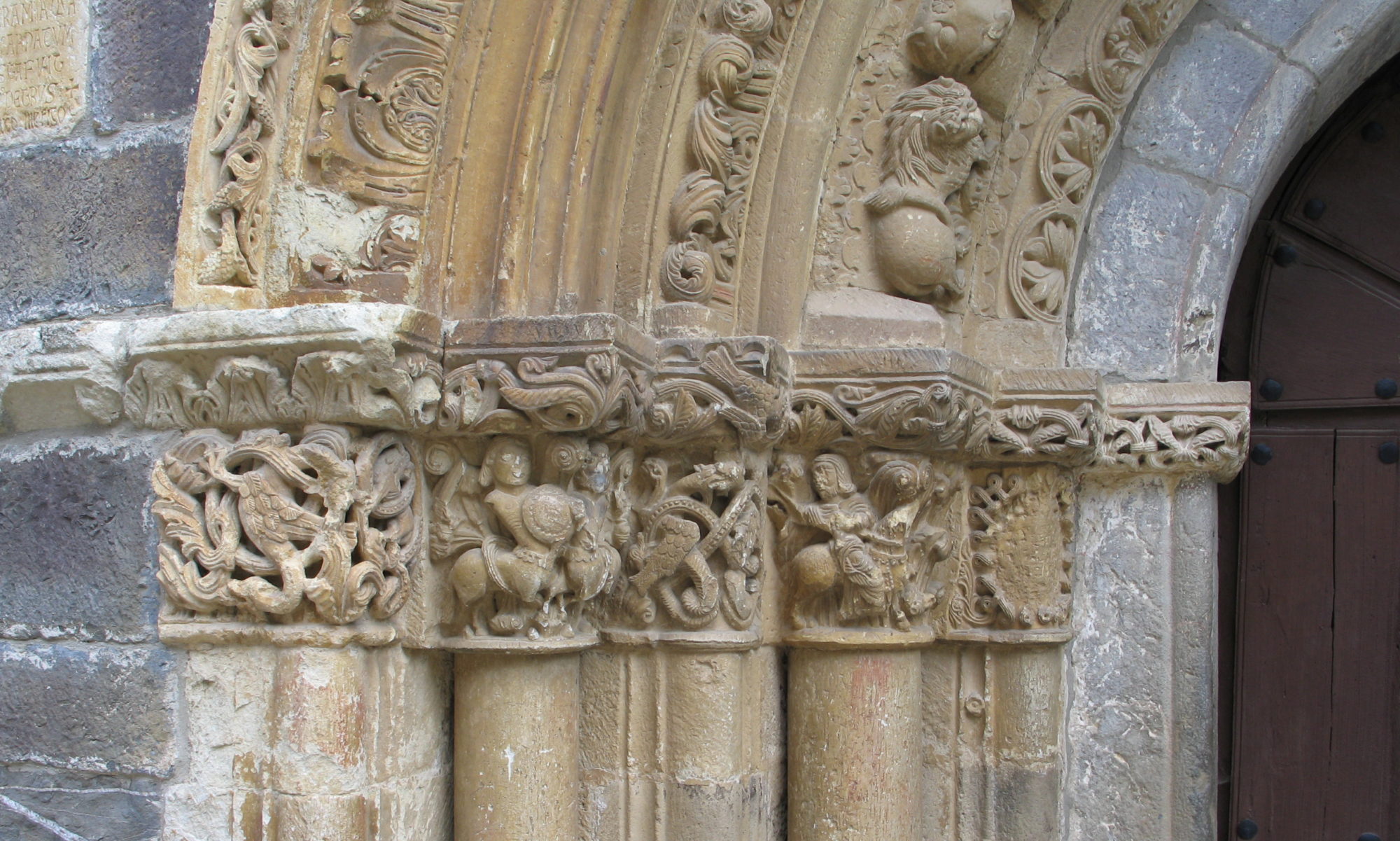
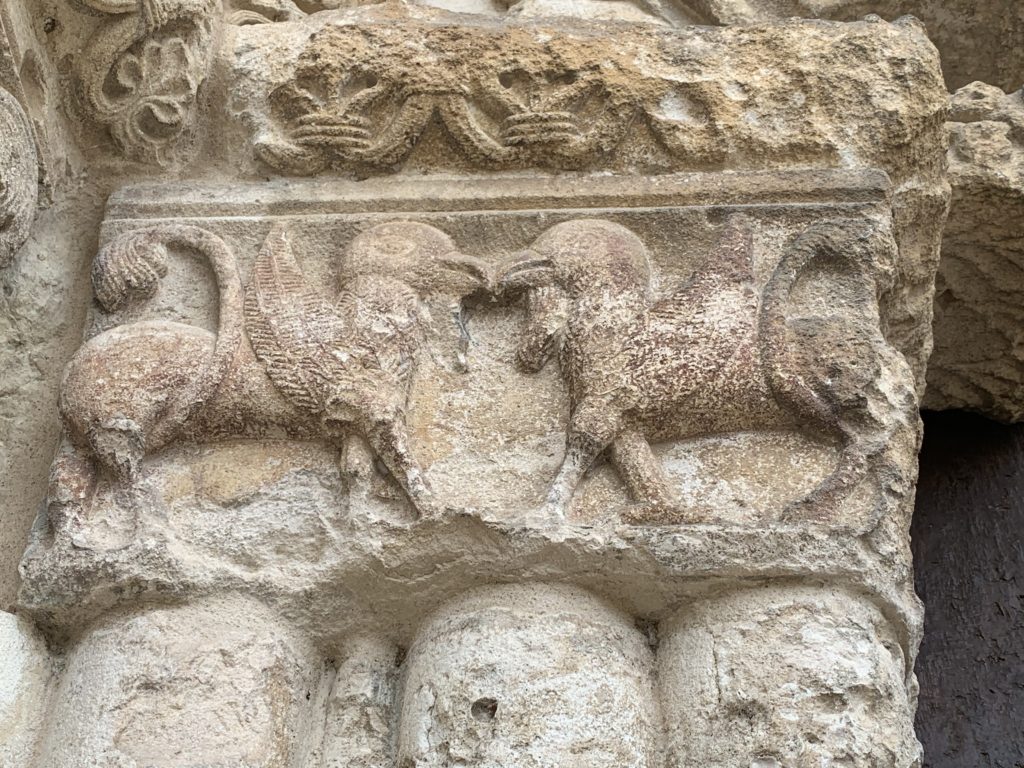
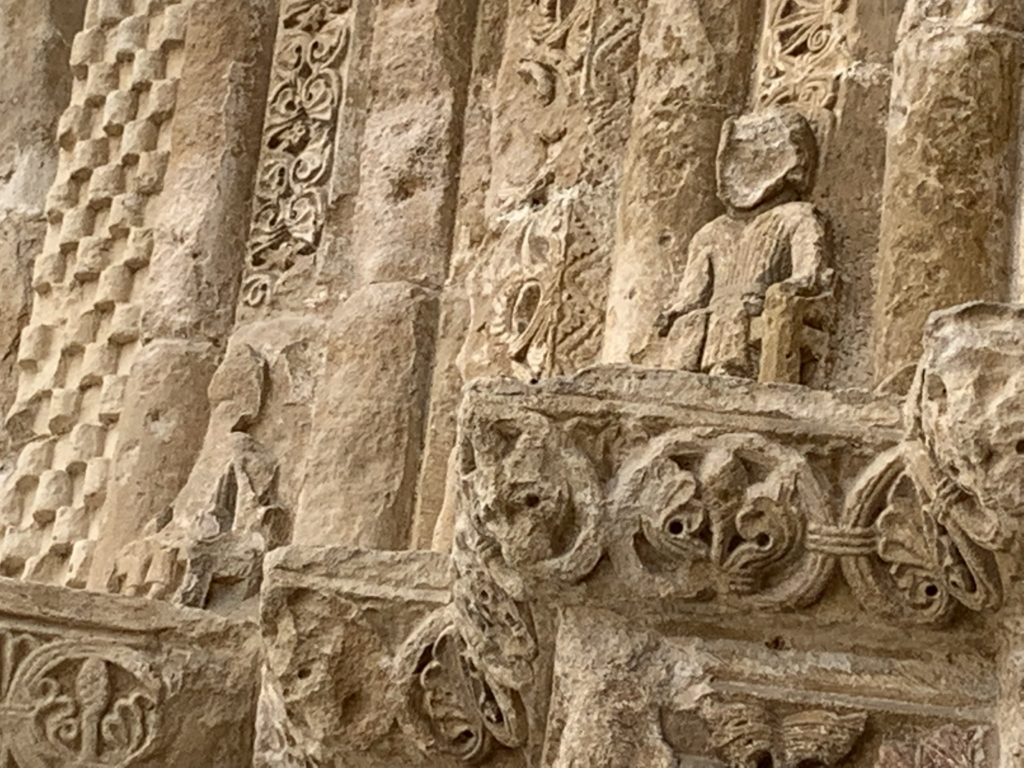
Look closer at some of the figures on the portal, like these two facing griffins. See the detail still preserved on their wings, and what looks like maybe traces of paint.
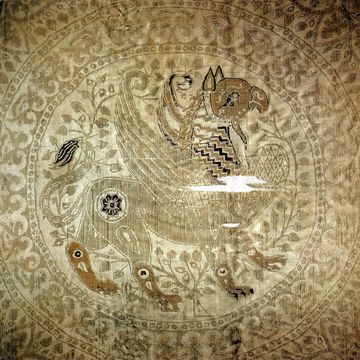
Compare it to this silk roundel originally wrapped around the relics of Saint Siviard and now in the treasury of Sens.
Imagine what it would have looked like if the portal had all been painted. Not the somewhat austere, stern, pure stone we see today but a riot of colour, more like a series of silk textile borders. I also like the little stone guys on thrones. I’ve never seen that before.
It’s not a church, but the Romanesque palace has some interesting sculpture too.
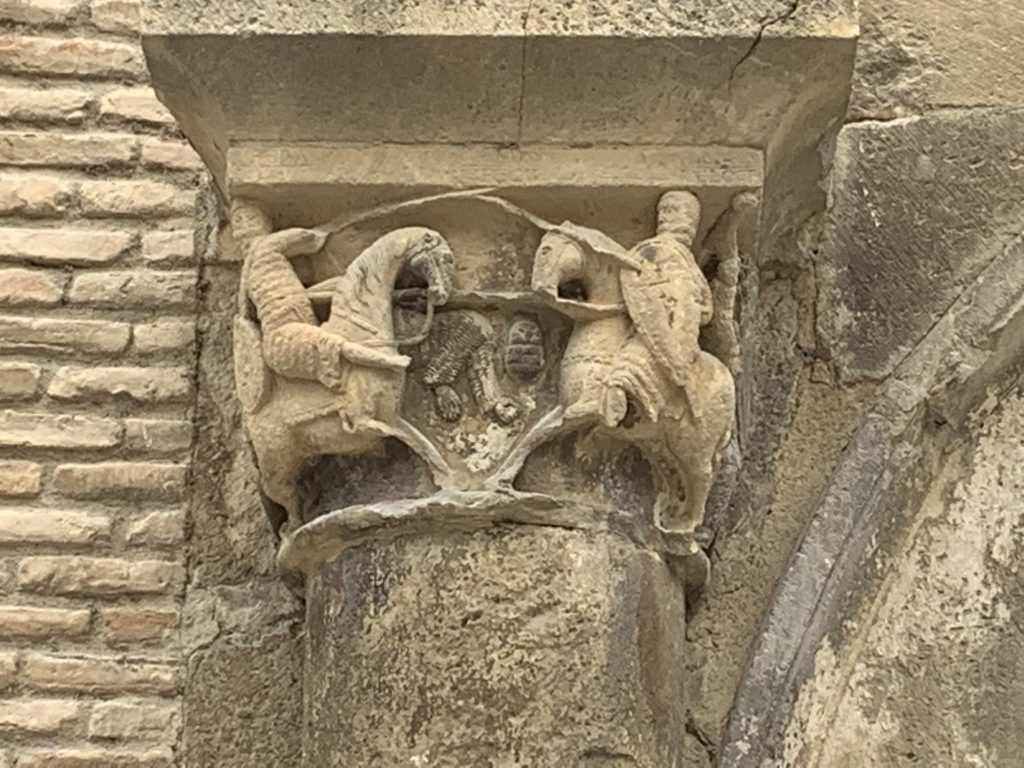
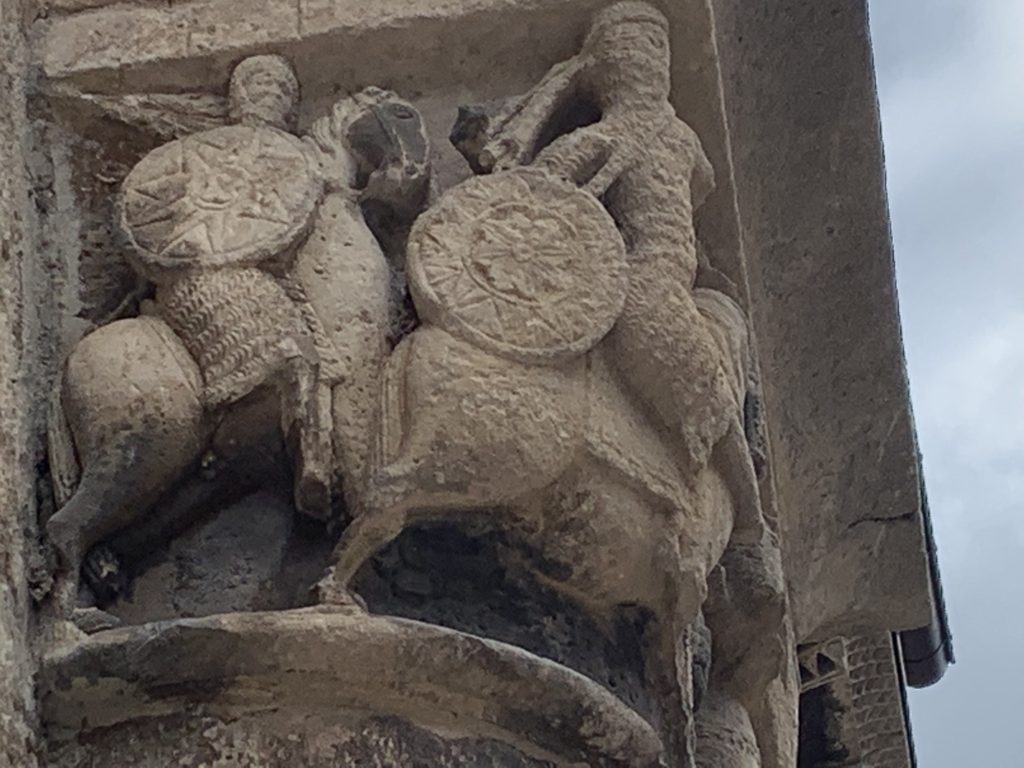
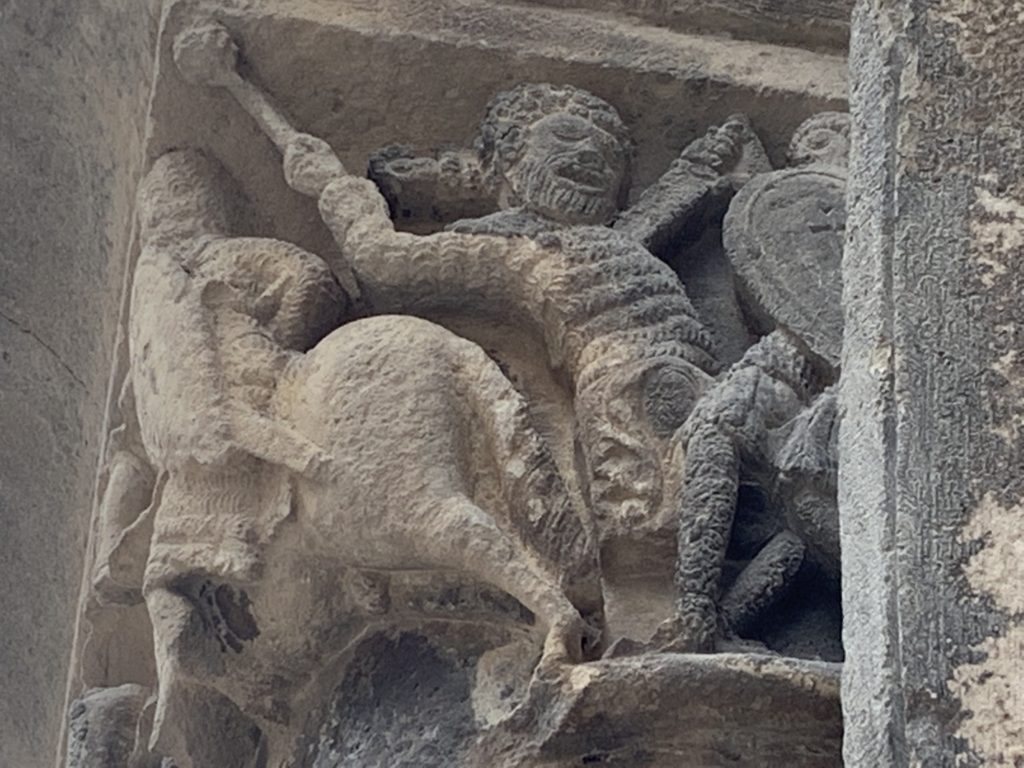
This capital shows Roland fighting against the giant Ferragut, part of the tale of Charlemagne in Spain found in the Pseudo-Turpin chronicle. Their battle supposedly took place outside Nájera, a few days further on the pilgrimage road.
I love the detail you can see here on their shields and their chainmail.
Here is Ferragut himself. Evidently he and Roland paused their fight many times, to discuss the finer points of their theological differences.
But I had other reasons to be interested in Estella. This town, like many others on the pilgrimage road to Compostela, had an important Jewish community throughout the Middle Ages, and when I wrote Pilgrimage, my historical novel about the twelfth-century Camino, I set an important scene among the Jews of Estella. If you have read the novel, it is the moment when Gebirga is travelling with Yusuf, a Mozarabic Christian, and two Jewish traders. They stay with a Jewish family in Estella over Shabbat, much to Gebirga’s discomfort. That evening, their prayers are interrupted by news that their slaughterhouse, down by the river, was on fire. They confront a Christian mob, whose leader tells them a story of seeing a Jew throw a crucifix into the river. At that very moment, he says, the Jewish slaughterhouse caught on fire. When asked who it was he saw, the ringleader points to Yusuf who takes to his heels. Half the mob follows him, and a brawl erupts between the other half and the Jews. It ends in a draw, but Yusuf remains missing.
When I came to Estella, I wanted to see how well what I had invented matched what was there. I based many features of this episode on stories about the Jews of Estella, including a story that the Jewish women of Estella had their own synagogue, and the anti-Semitic legend of the Jew throwing a crucifix in the river. My source for a lot of my knowledge about Jewish communities along the Camino is David Gitlitz and Linda Davidson’s wonderful The Pilgrimage Road to Santiago: The Complete Cultural Handbook
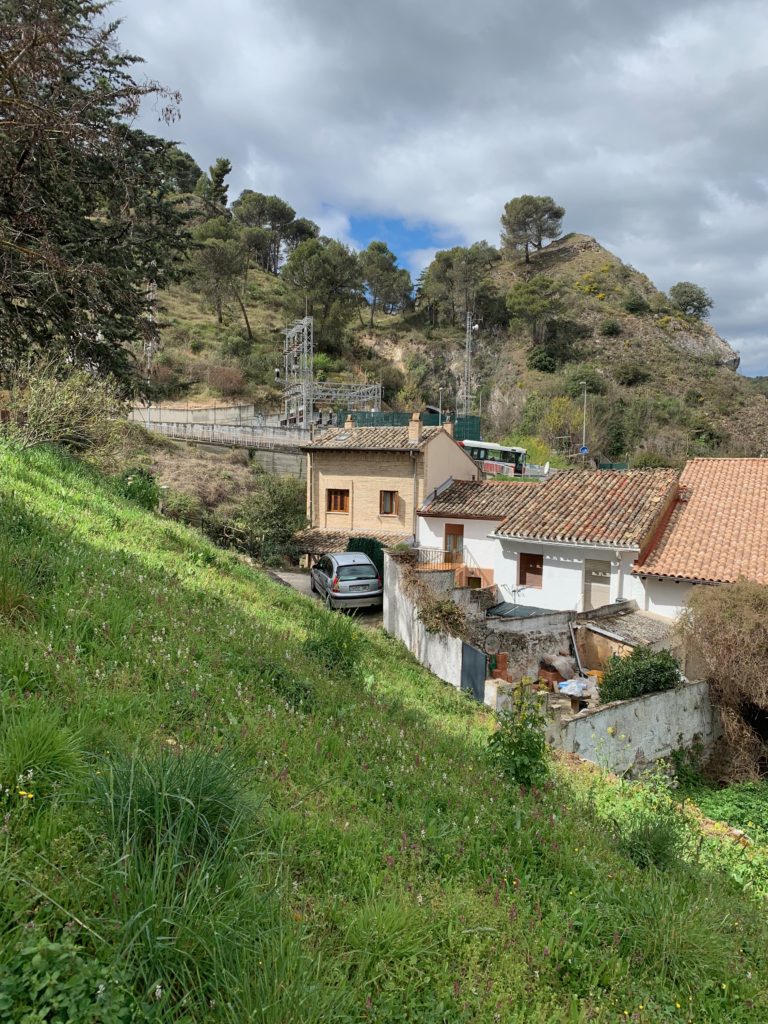
The Jews of Estella were moved around during the four hundred years they lived in Estella, but when Gebirga would have stayed with them, around 1120, their community was on the hillside above the pilgrimage road and the river, up behind the albergue where I was staying. You can see a few house here in the photo, but much of the area is open, and occupied by a bypass highway, just out of sight beyond these houses. Its emptiness makes it easier to remember and imagine the lost community, easier for me than in Toledo or Barcelona.
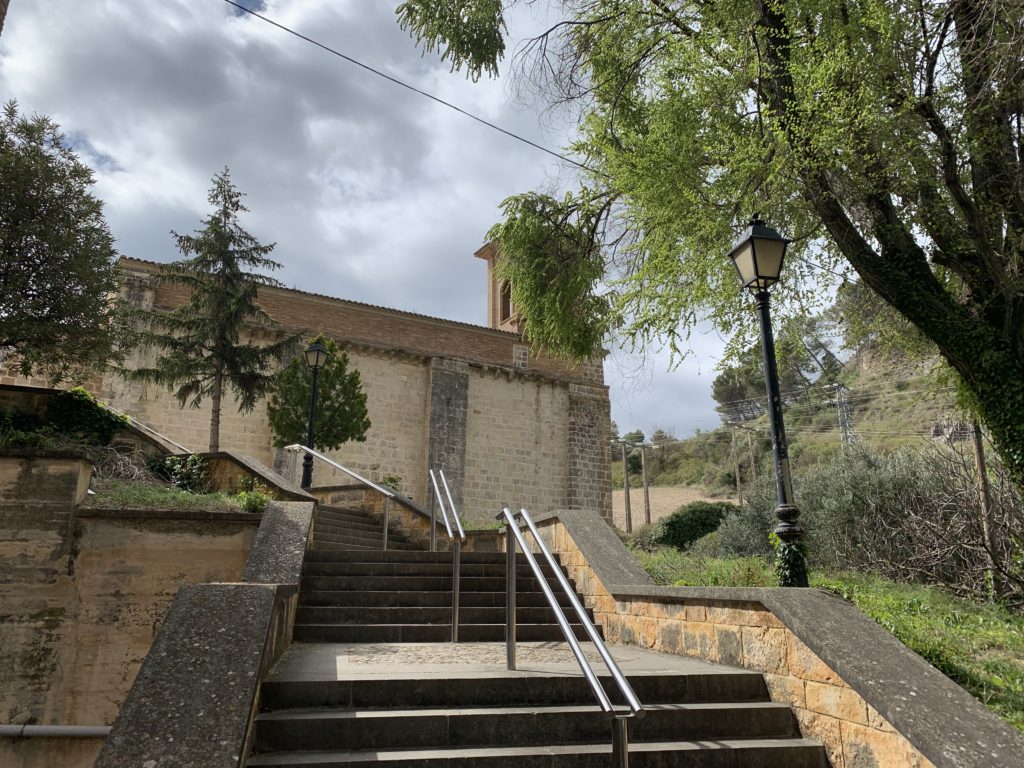
The church of Santa Maria, here, was built on the site of the synagogue where the men would have prayed in Gebirga’s day. It was taken from by the king and given to the bishop of Pamplona to build this church in 1144.
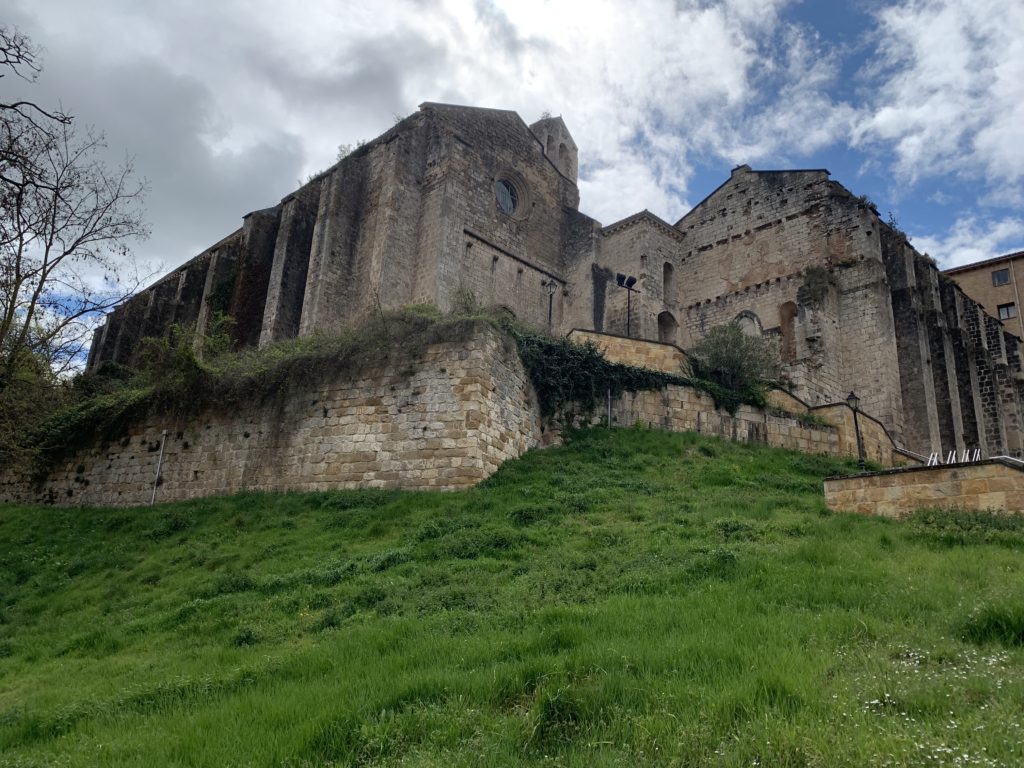
To the left, and facing where the Jewish community would have been, was this big pile, now an old folks home, but originally a Dominican monastery, built in 1258. Those who study relations between Christians and Jews in Spain know that in the thirteenth century, Dominicans, the “Order of Preachers,” gained the right to be able to force Jews to listen to them preach. In this community, evidently they also taught Arabic. I have read about this and known about it for years; in Estella for the first time I could feel what it would have been like to have this Dominican presence imposed on your community.
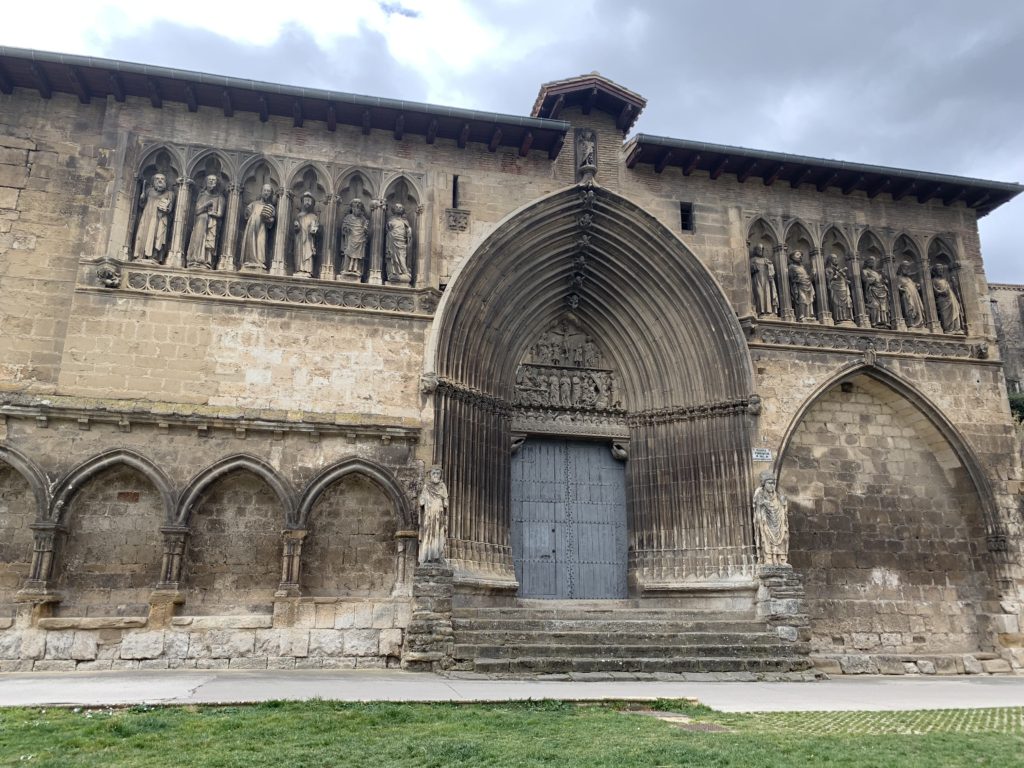
This church has been locked since the late nineteenth century so all you can see is its facade. It sits right on the pilgrimage road into town, opposite the river. It is the church of the Holy Sepulchre, and it was originally built on the site where the Jew was supposed to have thrown the crucifix into the river. This facade dates from the fourteenth century, but as you’ll be able to see, its creators had their minds very firmly on the Jewish community that surrounded it even then.
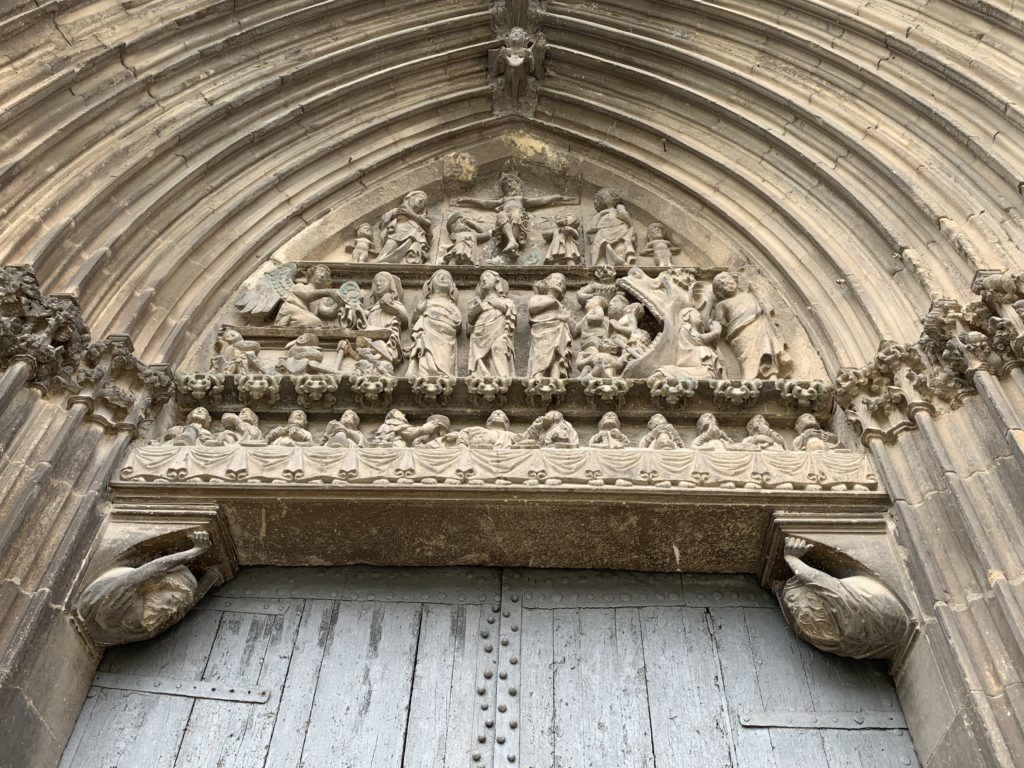
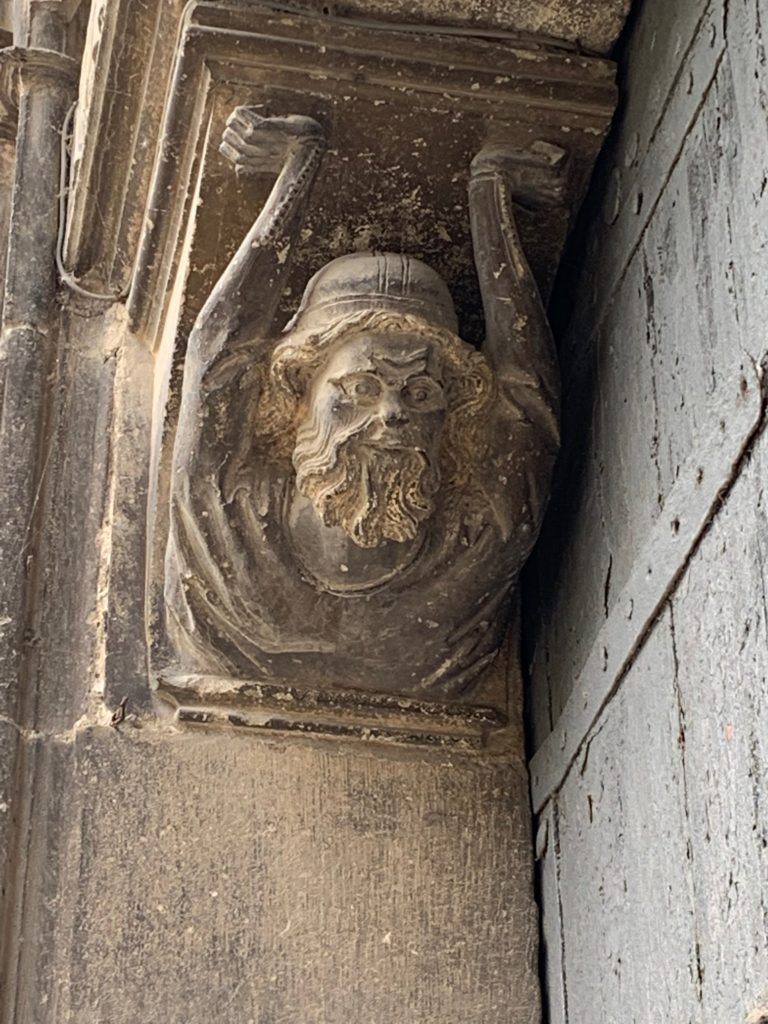
The tympanum at the centre shows scenes from Holy Week — the Last Supper on the bottom; the Crucifixion at the top, the cross flanked by Mary and John; and in the middle, the harrowing of Hell, the women at the tomb, and Christ appearing before Mary Magdalene. But look at the figures holding up the tympanum.
They’re Jews. It’s a disquieting image and there are many ways to interpret the two figures. They hold up the Crucifixion and Resurrection the way what Christians call the Old Testament holds up the New. Perhaps Jewish taxes paid for the church — given the location of the church this would not be surprising. It may not even be an entirely negative depiction. At a time when Jews were increasingly being marginalized in Spain, their physical presence here makes a case for them to have a place, however fraught and marginalized, in Christendom.
Estella has had a troubling and difficult history, only a small part of which I have talked about here. It is also beautiful, only a small part of which I have shown you here.
I just learned today from a friend on Facebook that the composer Galt MacDermott died two days ago. Most people will know him from “Hair” and maybe “Two Gentlemen of Verona” but it is also worth remembering the important role he played in fostering the Canadian arts world.
In the late 50s, he and several friends produced an original musical at McGill called “My Fur Lady” that had a far reach at a time when the Canadian arts scene was almost non-existent. It was a satire about Princess Aurora Borealis of the territory of “Mukluko” and her attempts to find a husband so she could preserve the independence of her realm. The love interest is the governor-general (I told you it was satire). It is a light piece, in many ways, but it is also a touchstone of Canada as it was in 1957-58 and it was enormously successful, playing across Canada, including at the Stratford Festival. It was produced at a time when Canada was just beginning to expand into the Arctic in a big way, and in the run-up to Expo 67, when Canadians were beginning to think that they needed to develop more of a national identity. The song embedded below plays on that. An identity had to include an indigenous arts scene, not just what could be borrowed from Britain or the States and McDermott was not the only of its producer to go on to success in the arts, though the rest stayed closer to home. James Domville developed the National Theatre School and ran the National Film Board (It was under his tenure that “If you Love this Planet” was produced. I remember being trouped into the reception room in high school where we all watched it to see how the crazy man running the States was going to kill us all). Don McSween was the administrator for the National Arts Center. Tim Porteous worked for Pierre Trudeau for many years and also ran the Canada Council for the Arts, a grant-giving organization, itself founded in 1957.
And then there’s my Dad. My Dad was the stage manager for the production and as a result of spending all his time on that, flunked out of McGill. He ended up okay though.
It has been a very long time, after all, since Jews anywhere in the world routinely wore or wielded swords, so long that when paired with “sword,” the word “Jews” (unlike, say, “Englishmen” or “Arabs”) clangs with anachronism, with humorous incongruity, like “Samurai Tailor” or “Santa Claus Conquers the Martians.” — Michael Chabon, “Afterward,” Gentlemen of the Road
When I was little and Remembrance Day rolled around on November 11, I would always be slightly ashamed and confused that neither of my grandparents fought during World War II. When I was a little bit older, old enough to enjoy looking through my grandmother’s stack of old family photos, I learned something new. Maybe nobody fought in World War II but they did fight in World War I. On the wrong side. This year, on the hundredth anniversary of the armistice, I decided to investigate.
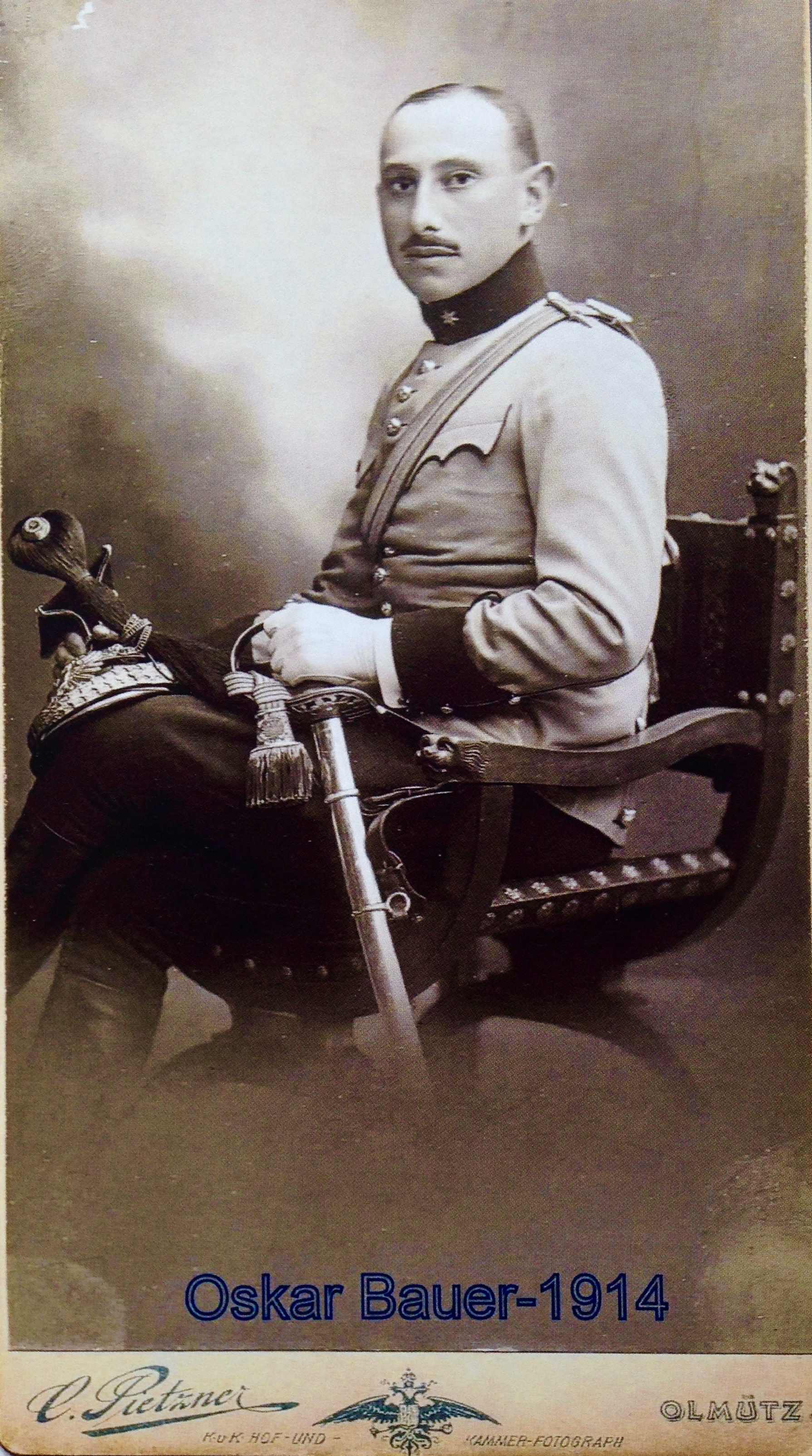
I pulled out this photograph of my great-grandfather Oskar Bauer, and did some research. From the Verordnungsblatt für die Kaiserlich-Königliche Landwehr, Volume 37 of 1907, I discovered that at that time, he was a Kadett-Offiziersstellvertreter in the Uhlans regiment, number 4. What does that mean in English? The Kaiserlich-Königliche Landwehr was the Imperial-Royal territorial army of the Austrian half of the Austro-Hungarian Empire. In 1908, the Austrian army changed the title of cadet-officer’s deputy to that of ensign. By February 17, 1915 he had been promoted to Lieutenant, according to vol. 46, no. 17, p. 210 of the same source. The Uhlans, with the separate regiments of Dragoons and Hussars, formed the cavalry of the Austro-Hungarian army, and he was in the “Kaiser’s own” 4th regiment. Its normal home was at Olmütz, now Olomouc in Czechia, where this photograph was taken in 1914, and its composition in the same year was 65% Ruthenian, 29% Polish, and 6% “various.”
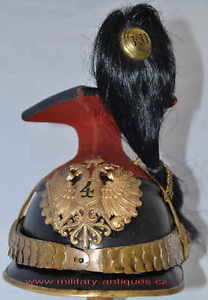
In the photograph, you can see his sabre in his left hand, and on his right knee, a helmet that would have been identical to this one, and which harked back the the origin of the Uhlans as a Polish cavalry regiment. As World War I opened, the 4th Uhlans were part of the Austro-Hungarian 3rd army, under the command of Rudolf Brudermann. They were sent north into what is now Poland with the 1st through 4th armies to face the Russian army in what would become the Battle of Galicia, a decisive loss for the Austro-Hungarian forces. The Fieldmarshal and Chief of General Staff Franz Conrad von Hötzendorf sent ten divisions of cavalry across the border to do reconnaissance on August 15th. On August 21st the 4th Uhlans met the Russian 10th Division in what was to be the largest cavalry-against-cavalry battle of the war near Jaroslavice-Wolczkowce, one of the last times horses were used effectively against each other. The battle of Galicia ended with some 400,000 members of the Austrian army killed, captured or wounded. Eventually, the Russians were able to take Przemysl, the third-largest fortress in all of Europe.
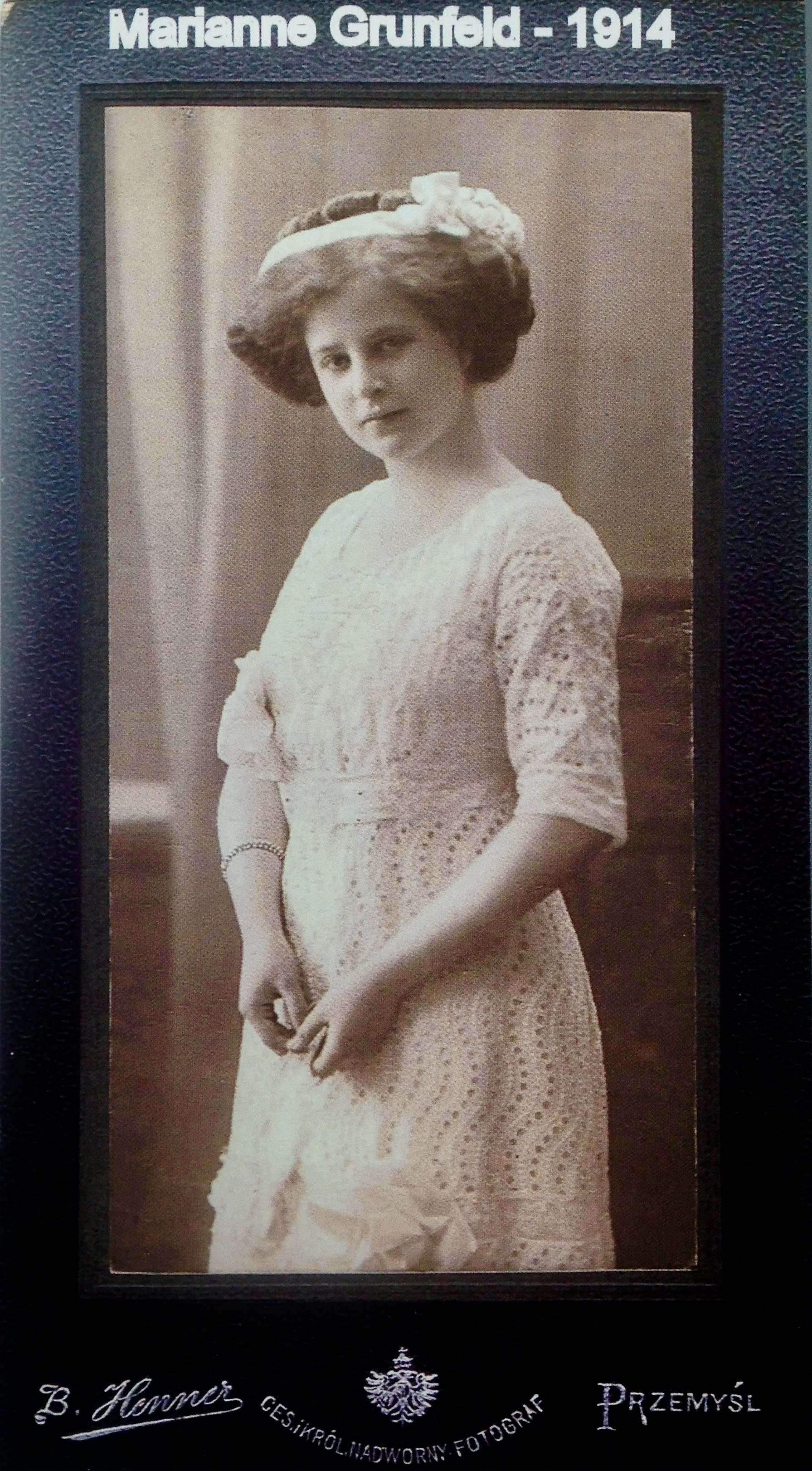
This photograph shows my great-grandmother, Marianne Grünfeld, and it was taken in Przemysl, evidently in 1914, which was the same year their first child, Oskar “Willy” Bauer was born. She was twenty and her husband was thirty-four. Przemysl was an interesting place — on the one hand, a major Austrian fortification and barracks and so a site for the elite Austrian military to gain fame and renown, and on the other, a town that had been majority Jewish in the eighteenth century with a population that ranged from comfortably wealthy to very poor. It was still 30% Jewish by 1931, the year before Joseph Roth published his The Radetzky March. Roth’s novel haunts my reading of these events of my family’s history. It is the story of the von Trotta family, grandfather, father, and son. The grandfather was a Slovene peasant-cum-soldier, ennobled at the battle of Solferino for saving the emperor’s life. The father becomes district commander in an unnamed town in Moravia where the regimental band opens every concert with the Radetzky March. Joseph Radetzky von Radetz, the Czech-born Austrian commander for whom the march was written was, for a brief yet never-forgotten time, the commander of the fortress and town of Olmütz. The son is a lieutenant in the Uhlans regiment stationed in his father’s town, until disgrace makes him shift to an infantry regiment. He ends up in a town like Roth’s own home of Brody, a smaller version of Przemysl, with its mix of Jews, Poles, and Ruthenians, and dies in the early days of the war, when my great-grandfather fought his cavalry battle.
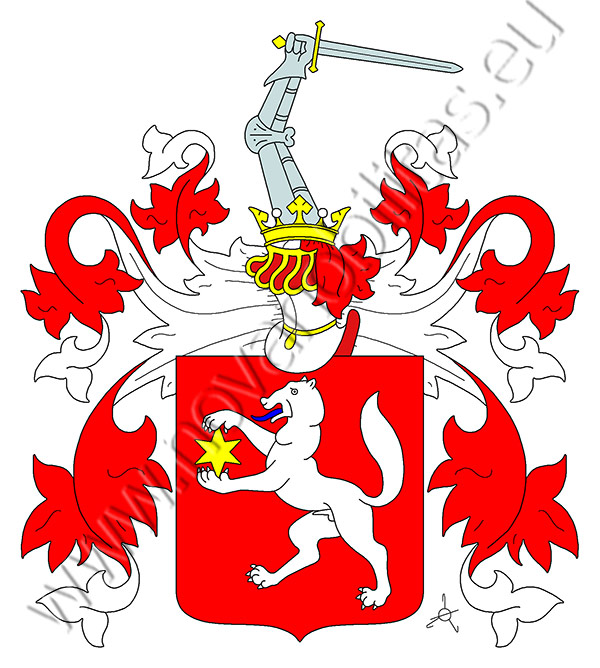
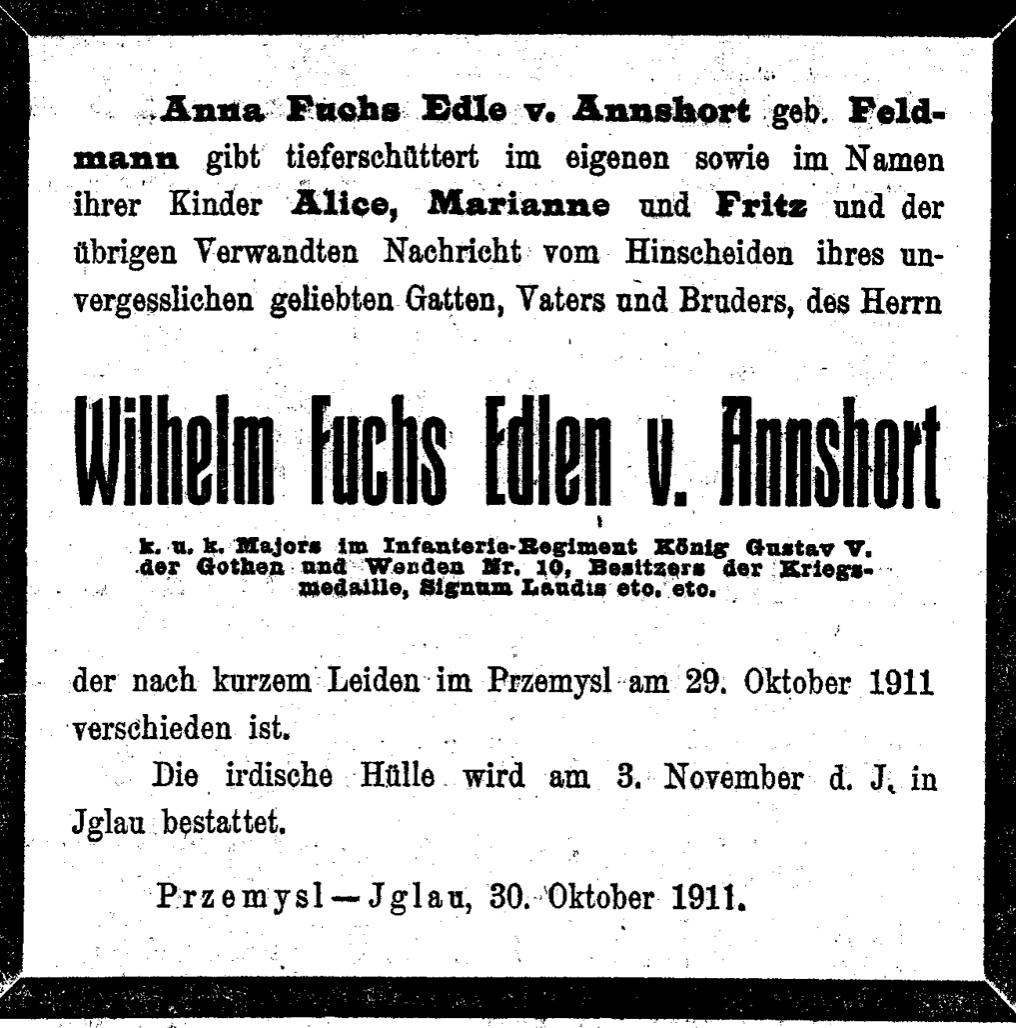
Roth made his military hero an ennobled Slovene, perhaps because he couldn’t quite imagine a Jew, ennobled for military service. But they did exist. My great-grandmother’s father died when she was only a year or so old, and her mother, Anna Feldmann, married Wilhelm Fuchs who was ennobled in 1908 as a captain, second class, in the infantry, with the title Edler von Annshort. This was his coat of arms. Note the star of David. He lived with his family in Przemysl, and died in 1911. I have often wondered what it was like to live as a Jewish noble and military family in Przemysl, on the borderline between the military elite and the shtetl. On the one hand, they were trying to assimilate as much as they could, and succeeded to the degree that Fuchs was ennobled and earned the Signum Laudis, a medal awarded to officers for military merit. On the other hand, no one ever forgot they were Jews. Marianne and her sister Alice both married army officers; Marianne and Alice both married Jews.
When my grandmother was a young girl, Marianne and Oskar had her baptized, still trying hard to assimilate and erase their differences with those around them. She reconverted to Judaism to marry my grandfather (perhaps the only person to convert *to* Judaism in central Europe in 1936). My great-grandparents, as I have said before here, died at Auschwitz. I don’t know when or how Marianne’s mother, Anna Fuchs Edle v. Annshort, died. I know she was alive in late 1937/early 1938 because we have a photograph of her holding my father. I can guess.
The books have been signed, the taxis boarded for O’Hare, but before we all move on to the next adventure, I wanted to write about few of the things I learned and lessons I valued from yesterday’s conference, “Medieval Imaginings: A Celebration of Historical Fiction.” Organized by Barbara Newman as one of the last events sponsored by a Mellon grant that has brought so many exciting ways to think of the Middle Ages, not only to Northwestern University, but to all of us in the Chicago area, the day gathered together students and teachers, historians and literary scholars and writers, as well as a few people who were all of the above.
Cecelia Holland, last but not least, was my favourite part of the day. She read a few passages to us from her 1997 novel about the Templars, Jerusalem, and every time she stopped, I wanted to shout, “No! Keep reading! I have to know what happens next.” But even more than that, she talked about how, when you write about the past, the past must connect to the present. The past is gone; we are here, and it is for us that we are writing. Before she started reading, she spoke about the place she was in when she began the book, about teaching prisoners how to write, about how she loved them and how they were desperate and hardened, hopeless and full of longing, and how writing gave them the chance to be themselves again. We could see those prisoners in the Templars she described, Rannulf and Mouse the rest.
I learned other things too. From a thoughtful discussion of sources and the uses we make of them between Paul Strohm and Bruce Holsinger (whose Invention of Fire we eagerly await), I discovered that I am more fearful of the claims made by historical biography than historical fiction. I know this comes from reading Robertson Davies’s What’s Bred in the Bone as an impressionable youth. Its twin story lines of biographer and subject force us to recognize all that the biographer can never know. I learned that my own initial stirrings of an idea to write a novel about the medieval pilgrimage to Compostela must have begun very close to my reading of Sharan Newman’s novel with the same theme, Strong as Death.
We spent a little too much time talking about Dan Brown. We don’t get upset when someone writes something wrong about the Middle Ages that sinks like a stone; we get upset when it sells a lot of copies and makes a lot of money. My own explanation, not voiced at the conference, for the popularity of The DaVinci Code (and 50 Shades, and Harry Potter) is that they are easy to read, their themes and claims are big, and they satisfy a longing we have for a shared text, now that the Bible no longer fills that space. One question that came up over and over again was whether we are doing the right thing, drawing on the past for the needs of the present, slicing it up and making stories out of it with beginnings, middles, and ends; with character arcs and conflict resolved. What if people read what we write and…believe us? And what if we’re wrong? As we are, as we all are because, remember what Cecelia Holland said: the past is gone. My serious answer to this question is that I would not put my name on any piece of writing I was not prepared to stand behind, with all of its longing, and failure, to hear and convey a voice that is not my own. This is as true of my historical as my fictional writing. My flippant answer (But felt no less strongly. Maybe felt more strongly.) is that, who cares if it is wrong and they believe it? The only problem would be if, “and they believe it,” meant, “and so they stopped telling stories of their own.” Of course it is wrong. I read a history and I tell a history, then you read it and out of that your own history emerges, and together a great chain of stories continues to grow, connecting us and allowing us to share in each other while becoming more thoroughly our selves. Long live stories, and the people with the courage to tell them, and believe them.
I think the writer at the conference may have been the best historian in the room.
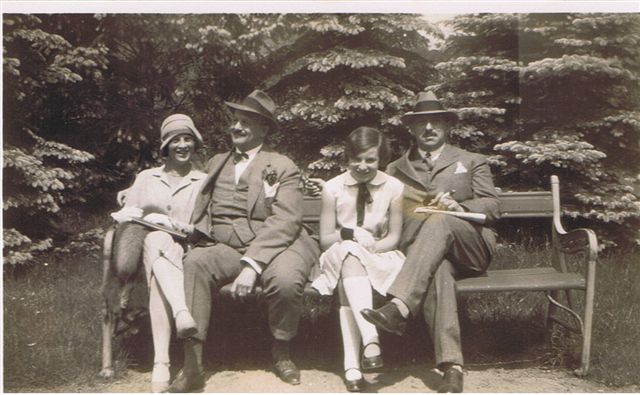
L to R Marianne (Grunfeld) Bauer, Fritz Waldsheim, Liska Bauer, Oskar Bauer
My father died in July 1987; my uncle told us about our Jewish background that same summer; in 1989 the Berlin Wall came down, and in June 1993, my sister and I went to Czechoslovakia (as it still was then, though not for long) with my grandmother, Liska. Travelling through Prague and the Czech countryside with Granny was like listening to Marcel Proust. We would turn a corner, she’d see a building, and the stories would pour forth. A visit to the the Kinsky palace, in Chlumec where my great-grandparents had lived, reminded her of how when they’d pass it on their weekly drive between Prague and Hronov, my Gumper would tease, “Don’t look up. The Count will invite us for lunch, and we just don’t have time.” In the Prague Castle, we saw the Spanish Hall where she went to a Red Cross Ball then, “That’s the Schwartzenburg Palace,” she exclaimed before one sgraffitoed building, and told us how it used to be the Swiss embassy, and how she had gone there to beg (successfully) to have her Swiss visa extended, though she did not yet have her exit permit from the Gestapo. To get the permit, her father bribed a high Nazi official who came to their house and was “decent to them” and gave her the right permit. All my photos of this trip show my sister with her arm around my small Granny, holding her and protecting her.
We went to the farm where she grew up in Herelec, and the second floor apartment on Anny Lekenske street in Prague, where she moved with her parents and brother. And a lot of the stories she told were about her parents, especially Marianne, her mother. Marianne was born in 1894 in Jihlava, or Iglau as it was called then. Her father, Julius Grünfeld died the year after she was born and her mother, Anna Feldmann, remarried a man named Fuchs who had been ennobled with the name Fuchs-Anshort. It seems that Marianne lost contact with her father’s family, but just in the past year my sister and my niece have been able to reconnect with a branch descended from Julius’s oldest brother. They…look like our cousins! Which they are.
Marianne’s step-father was an army officer, and moved the family to Przemysl. Now part of Poland, it was then in the Austro-Hungarian Empire, where it was a crucial crossroads for trade, and a strategic barrier against the Russians. Some of the most important battles in World War I were fought there. It was also home to an ancient and substantial Jewish community, which formed a third of the population of the town. There, this ennobled sophisticated family, whose livelihood depended on assimilation to the norms and values of the Austro-Hungarian Empire and its military, encountered, perhaps for the first time in large numbers, the Ostjuden, whom they would have seen as threatening and strange. It is perhaps this experience that best explains Marianne’s indifference, or perhaps better, hostility, to her Jewish background. The nineteenth-century emancipation of the Jews was not just an emancipation from the punitive restrictions of the state; it was also, for those who chose — and the families of both my father’s parents did so choose — an emancipation from the rabbis. Her son, Willy, was not circumcised at birth (and, poor boy, medical problems caused him to have to undergo circumcision as a youth). My grandmother’s name was entered in the record of Jewish births in Iglau, but the same document also records her abandonment of the “israelische religion” at the age of three to become a Catholic. Granny showed us the church where Marianne encouraged her children to participate in the Ascension day procession, and she told us how a crew of thirty Slovaks would come to bring in the harvest in the autumn. They wore their national dress on Sunday and to her mother’s delight, made grain crowns for the family, which they would keep safe until the following year. These folk customs delighted Marianne, but she showed no interest in her own tradition. Moreover, she identified herself with the traditions of Austria, not this new country of Czechs. Granny showed us the old Deutsches Haus in Prague where Marianne would go to meet friends. “Of course,” my grandmother then said under breath, “They all became Nazi collaborators.”
My grandmother loved her mother; you could hear it in her voice. The photos show them smiling together like sisters, my grandmother a little shorter, plumper, and more ordinary-looking than her elegant mother, but raised to be strong, and to value herself. I have a few things that belonged to Marianne: the family portraits that were passed down through the daughters of the family, her handwritten recipe book, a pair of earrings — chased gold lozenges, each inset with a pearl. My grandmother loved clothing, and she loved to go shopping, a trait she passed down to her granddaughters, though she wasn’t interested in labels, and she despised the boutique-ification of women’s fashion (one of my favorite stories about my Granny was her tale of walking into a Valentino boutique and picking up some of the garments, whereupon the salesman rushed up to her, distressed that she was touching the clothing. “Madame,” he said, “You mustn’t touch. If you want something I will help you. This is haute couture, you know.” Granny turned to him and said, “THIS is not haute couture; THIS is prêt-à-porter,” and stormed out of the shop.) When she died, we divided up her clothing, and one of the pieces I chose was Marianne’s alligator purse.
On December 14, 1941, Marianne and her husband Oskar were sent to Theresienstadt, and on January 20, 1943 they were sent to Auschwitz, where they perished. They had visas for Cuba, but Oskar said, “What do I want to do? Live in a hotel for the rest of my life?” and they did not go. My grandmother spoke to a survivor of Theresienstadt after the war who told her the last time he had seen her mother, she was smiling and taking care of the chickens. “And that is how I always like to think of her,” my grandmother said, voice shaking,’Smiling and taking care of the chickens.”