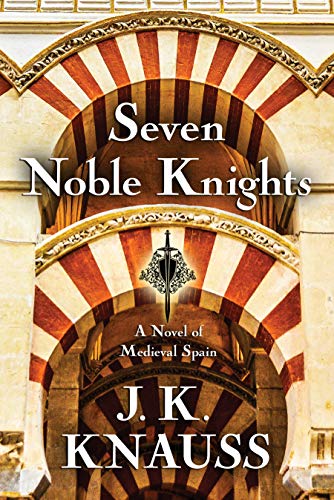
Jessica Knauss’s novel, Seven Noble Knights, brings to life a story from an epic poem that doesn’t exist. The tale of the seven sons of the noble Lara family, killed in vengeance during the tumultuous tenth century, is known to us today first from Alfonso X’s thirteenth-century Estoria_de_España and the Chronicle of 1344. Scholars infer from these two late sources, an original epic poem, whether an indigenous creation or one inspired by the epic poetry of the French, and they debate whether it and other early stories that found their way into the chronicle tradition are wholly imagined or have a basis in historical fact. I have myself written about a different tale from that period found only in later histories, that of Bernardo del Carpio, and I argued that story did have a basis in history, so I was eager to read Knauss’s version of this powerful story.
At first I was thrown off, because I was expecting a historicized version that takes the tale out of its later written form and situates it into the grim tenth century. What Knauss has done instead is to write the lost epic poem into the visual and material world of the thirteenth/fourteenth-century of its sources for it, much like, for instance, T.H. White did with the Arthurian tales in The Once and Future King, which placed later stories about a maybe-fifth-century king in a sort-of late medieval England of the imagination, a kind of no-time no-place. Once I realized what she was doing (and truly, only the five or six of us in the world who have spent too much time thinking about tenth-century Spain would be thrown off in this way), I settled down to enjoy the wild ride Knauss takes us on.
What I liked most about this book, is how true Knauss is to the spirit of her materials, and how uncompromising she is to the values of their time. Seven Noble Knights has the feeling of the epic poem it imagines. This is a world of blood and sex, of vengeance carried out personally by hand. These people are alien to us, what they care about, what makes them angry and how they deal with it, and Knauss allows them to retain this strangeness. Her use of language and her imagery emphasizes this sense of distance. These are not the characters of usual twenty-first century historical fiction, whom we imagine as “three-dimensional” because of their fictive interiority. Knauss’s characters are figures in the way that the characters of medieval literature are figures. We often call (or dismiss) them as stereotypes but I think Knauss’s book shows how powerful this kind of writing can be.
I felt this especially vividly with the character of Doña Lambra, who is the pivot point around whom so much of the action turns. While the centrality of the women to this story might surprise modern readers, it shouldn’t. Mercedes Vaquero, who has written brilliantly about this story and others like it, has argued that one of their roles was to create a space to discuss the fraught question of noble lineage, and women’s roles in creating and perpetuating it, and that women themselves may have been the patrons for these stories. I kept thinking of Vaquero as I was reading, and when I got to the end, lo, I discovered that Knauss had been her PhD student.
I think this novel will appeal to readers searching out a different kind of historical novel than most of what is published right now, a novel that doesn’t “bring you back in time,” but rather immerses you in a strange world and an unusual-to-us kind of story-telling.
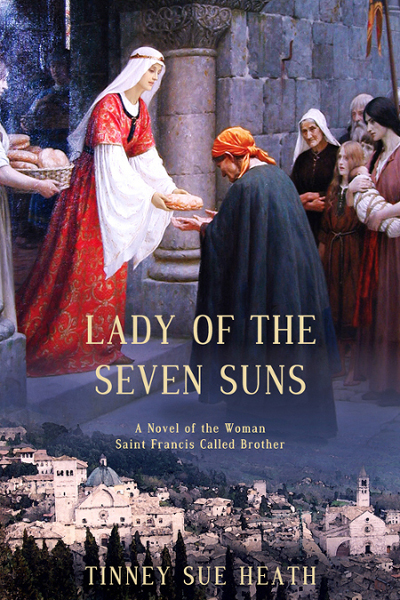
I’m delighted to post an interview with Tinney Heath about her most recent novel, Lady of the Seven Suns, about the Roman laywoman Giacoma di Settesoli and her relationship with Saint Francis of Assisi. Tinney has a background in journalism and a passion for medieval Italy. She is the author of several previous novels, including the recently re-released A Thing Done. You can learn more about her books, and join her newsletter at her webpage: https://tinneyheath.com
You set most of your writing in Italy. How did you come to write about Italy, and how did you come to be interested in the period before the plague when so many Italophiles focus on the 15th and 16th centuries?
It probably started when I was a teenager obsessed with Italian opera. I learned to speak operatic Italian, but I quickly realized it wasn’t going to do me much good, either for research or for travel. So in time I picked up some more practical Italian and finally made my way across the pond to Florence, and then I was hooked.
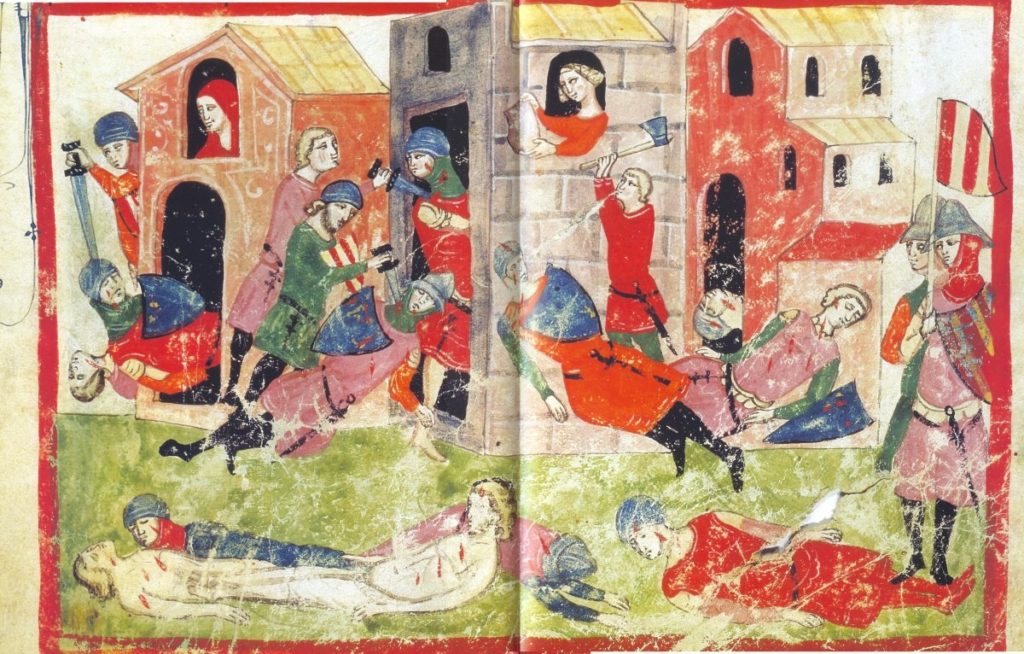
To my surprise, it wasn’t the High Renaissance of Michelangelo and the Medici that most fascinated me, but an earlier Italy, that of Dante and before. There was something alarmingly familiar in those constantly squabbling Guelfs and Ghibellines, battling each other in the streets of cities whose skylines bristled with forbidding stone towers.
Dante’s contemporaries and immediate forebears occupied a world unlike ours in many ways, and yet ours seems to be witnessing an upsurge in many of the same challenges they faced: drought, flood, famine, fire, epidemics, extremes of heat and cold, scarcity and want. And conflict. Always, conflict. Strife and contention, opposing factions jockeying for power. Fear and hatred, resentment and misunderstanding, xenophobia. Vilifying one’s opponents. Polarization. There is a certain immediacy in watching a long-ago society try to deal with these challenges, because we have only to look around us to see that despite our technology and our supposed advancement, it is all still happening. Perhaps there’s some hope in the fact they must have gotten through it somehow, or we wouldn’t be here.
You chose to show us Francis and Clare through the eyes of a third person, Giacoma di Settesoli. What drew you to her as a character, what do you think her perspective offers readers, and why have so few people ever heard of her?
I learned of Giacoma’s existence by chance, shortly before a planned vacation trip to Assisi. I was intrigued by the idea that a powerful, wealthy widow with strong political connections and control over a great deal of property could somehow become fast friends with the barefoot holy man who was devoted to Holy Poverty.
Giacoma remained a laywoman, uncloistered, able (thanks to her wealth, family status, and widowhood) to move freely around Rome and Assisi, largely unhampered by societal restraints that would have restricted her point of view. More than one contemporary account says that Francesco called her “Brother” and alludes to her close friendship with Francesco and with his other early followers.
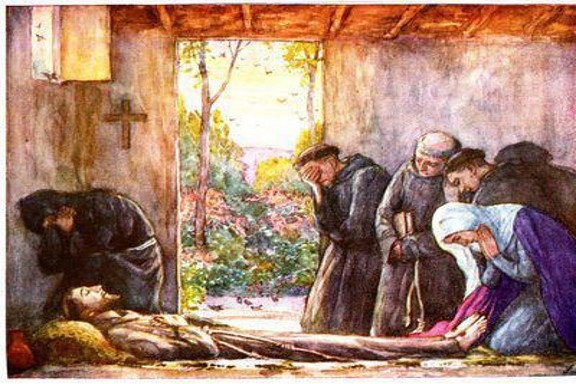
Giacoma at Francesco’s deathbed by Chilean artist Pedro Subercaseaux Errázuris, OSB (1911-1920s)
Francesco’s friendship with Giacoma is all the more surprising because he was so cautious about dealings with women. He wrote, “Let all brothers avoid evil glances and association with women. No one may counsel them, travel alone with them or eat of the same dish with them.” And yet this is the man who, on his deathbed, instructed his brothers that the prohibition on women entering the brothers’ compound need not be observed for her.
Why have so few people heard of Giacoma? Some scholars say that her obscurity comes from the 13th century Church’s reluctance to allow Francesco’s friendship with a woman to become part of the official record. Not wanting to sanction holy men fraternizing with women, the ecclesiastical authorities chose instead to ignore Giacoma as much as possible.
In the first two Church-mandated biographies of Francesco, written by Francesco’s contemporary Thomas of Celano, Giacoma is not mentioned at all. In Saint Bonaventure’s biography, written a few years later, her role is downgraded and the story of her presence at Francesco’s death is omitted. Historian Jacques Dalarun suggests that Bonaventure “exalted Clare, the cloistered nun, over Giacoma, the lay aristocrat, in having a special spiritual rapport with Francis.”
It wasn’t possible to expunge Giacoma from the record completely. We have writings from Brother Leo and others of Francesco’s earliest followers, and they talk freely about Giacoma, just as they talk about all the others who were part of Francesco’s life and brotherhood. The best the Church could do was to de-emphasize her, and that it did.
When officialdom couldn’t omit Giacoma entirely, it tried instead to emphasize the miraculous aspects of her story, thus leaving Francesco free of any suspicion. Her presence at his deathbed is a miracle because it was God who told her to go to Assisi; she was like the Magi because she brought gifts; and she was another Mary Magdalene because she mourned over Francesco’s body.
Francis and Clare are saints in the Catholic Church, and Giacoma herself is a “Blessed” — in fact (as I learned from you) her feast day is tomorrow. What were the challenges of writing a novel with broad appeal about important figures in a specific religious tradition?
Everyone has an idea of who Francesco was. To some he’s the gentle, loving patron of animals; to others, a simple man who wanted to follow in Christ’s footsteps and who was blessed with the stigmata. Many people, when asked, will start quoting from the so-called Prayer of Saint Francis (“Lord, make me an instrument of Thy peace…”), not realizing that this anonymous prayer appeared for the first time in the early 20th century in a French magazine. People of all faiths and of none revere Francesco, but most of them know very little about the times in which he lived or even about his personal history, which is more complex than all the sweetly-smiling statues suggest.
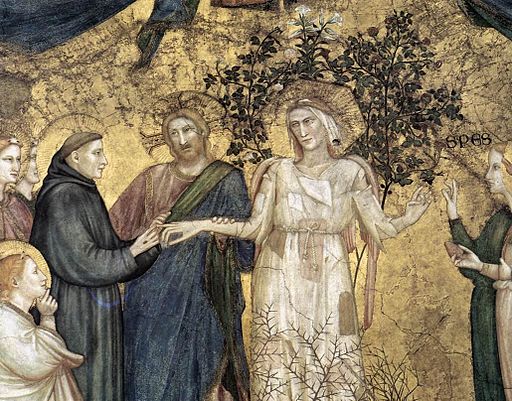
Francis Wedding Lady Poverty, by Giotto
That does make it a challenge to try to depict him in fiction without offending, so I simply wrote him the way I saw him – an extraordinary man, utterly original, midwifing (sometimes reluctantly) a religious movement that had to be constantly safeguarded from any hint of heresy. I am not Catholic myself, which probably made for a steeper learning curve when writing about 13th century religion. On the other hand, it prevented me from assuming that aspects of modern Catholicism applied to the church of Francesco’s time, which was not necessarily the case.
Are there any favorite stories about your characters that you weren’t able to work into the novel?
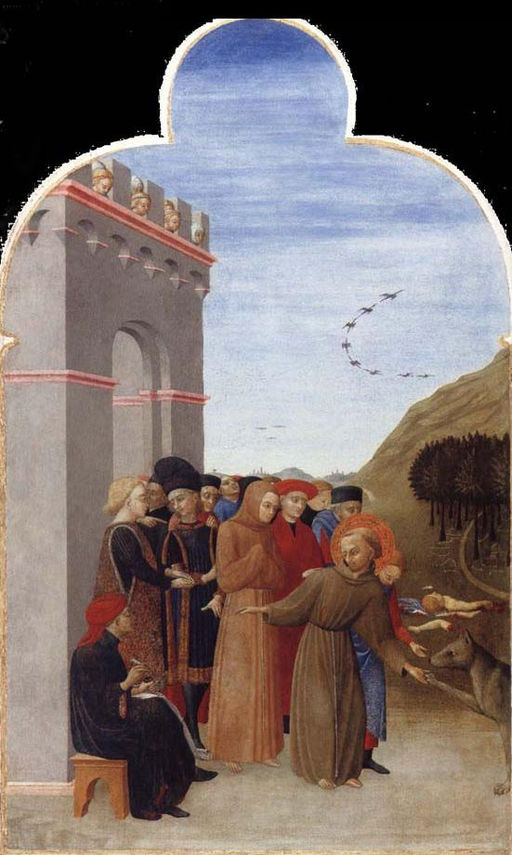
Yes, many. For instance, there’s the story about Francesco and the wolf, in which he charms, tames, subdues, converts, befriends, and negotiates with the ravening wolf that had been terrorizing the citizens of Gubbio. He does everything but enroll it in a twelve-step program, and by the time he’s done, the townspeople have agreed to feed it and let it live in Gubbio, and the wolf, by placing its paw in Francesco’s hand, has agreed to stop killing people and their animals. (Some say the “wolf” was actually a human outlaw harrying the city.)
Francis and the Wolf, by Sassetta
There’s a delightful painting by Sassetta in London’s National Gallery showing Francesco, the wolf, the people of Gubbio, and a seated notary scribbling away at their contract. Nothing could be more quintessentially Italian and medieval than that notary, who is no doubt trying to figure out how he’s going to obtain the wolf’s signature.
The other story I would love to have included was the rather bizarre turn Brother Elias’s life took after Francesco’s death, but my timeframe wouldn’t permit it. He somehow managed to go from being Francesco’s trusted Vicar General to the person entrusted with building the lavish Basilica to house Francesco’s relics (against the wishes of some of the earliest brothers), and from there to polarizing the order, serving as papal ambassador to Emperor Frederick II, getting excommunicated and thrown out of the order, and just to cap it off, riding into battle at the side of Frederick II. It’s said that children playing in the streets used to chant, “Frate Elia has gone astray, he has chosen the evil way.” (At least, that’s what they would have chanted in Guelf territory.)
Elias’s whole unlikely trajectory is fascinating and would make a wonderful novel. I’m not going to write it, but if somebody else does, I’ll definitely read it.
Thank you, Tinney! So would I!And I am looking forward to more books from you.
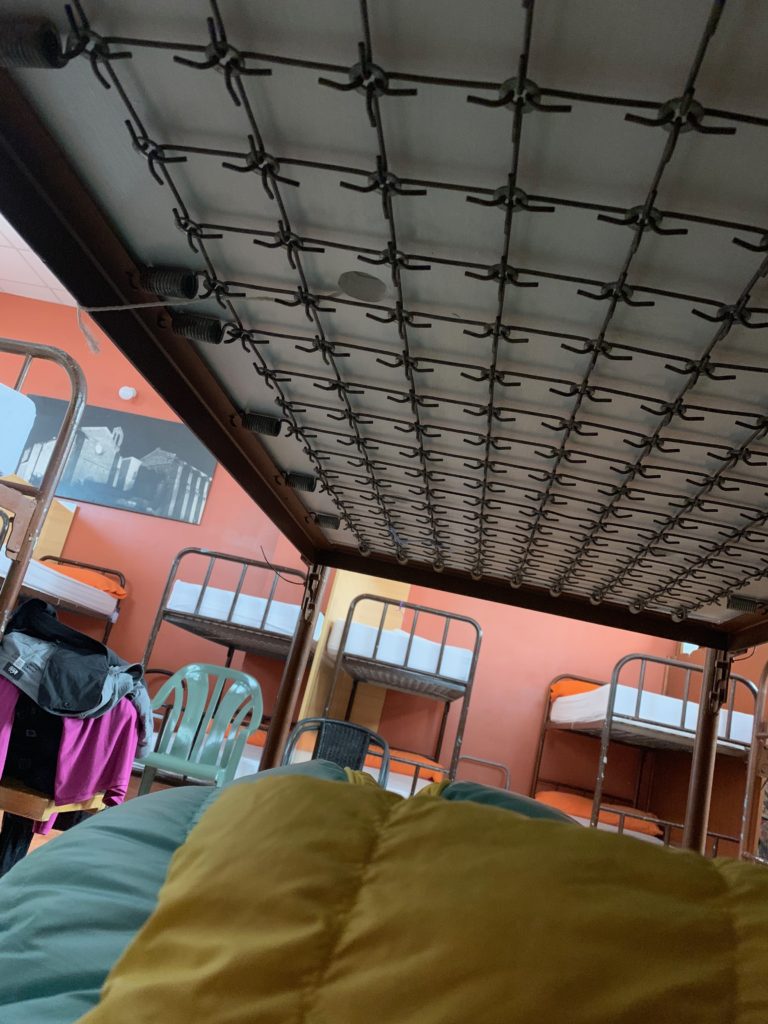
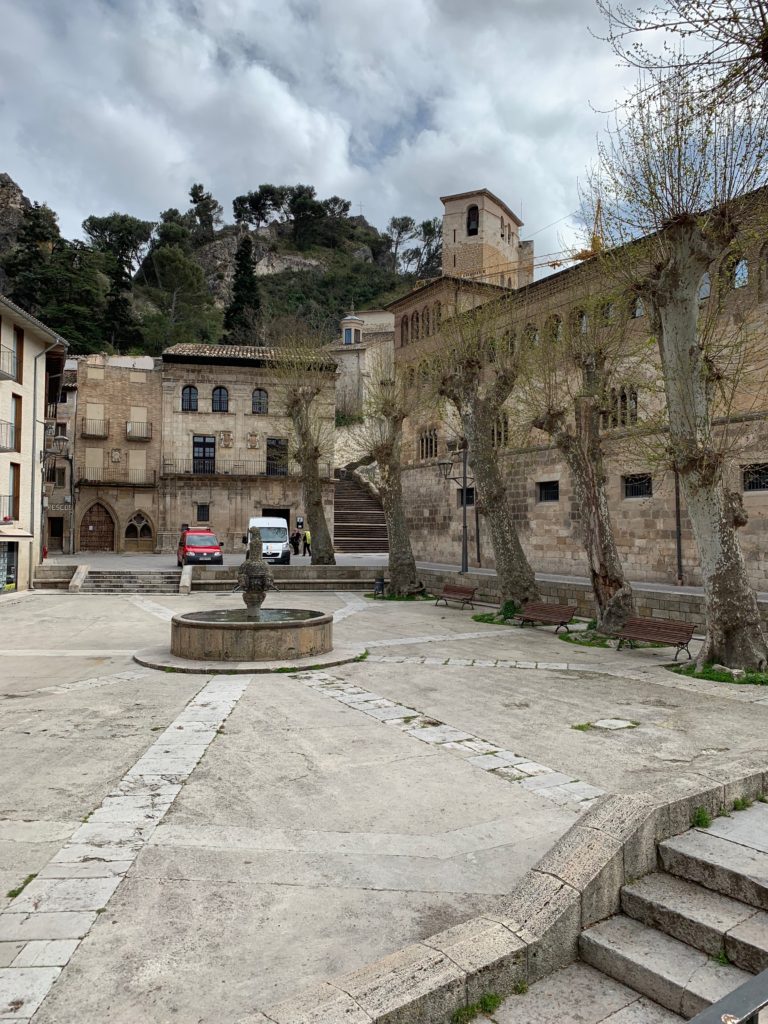
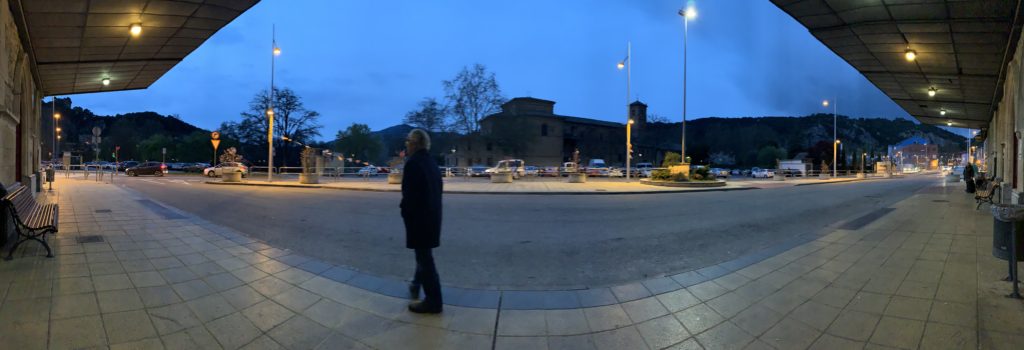
It was lucky and maybe surprising that I liked Estella so much, given that this was my view of it for most of the time I was there:
But Estella is lovely. Imagine the shell of a soft boiled egg once you’ve knocked the top off, leaving the sides jagged and craggy, and after you’ve eaten the egg out of it. Now imagine a town nestled in the bottom of the shell, with a river twisting through it.
In the Middle Ages, there were castles on many of these hills, protecting the town, which was founded in 1090 by King Sancho Ram irez of Navarre by annexing the fortified Basque settlement of Lizarra. The king’s plan was to move the main road, which is also the pilgrimage road to Compostela, out of the difficult hills above, so it could run more easily down through the flat. He encouraged settlers from France and also Jews to come live there, and they did, settling in what became three adjacent walled communities, and creating an important trading hub.
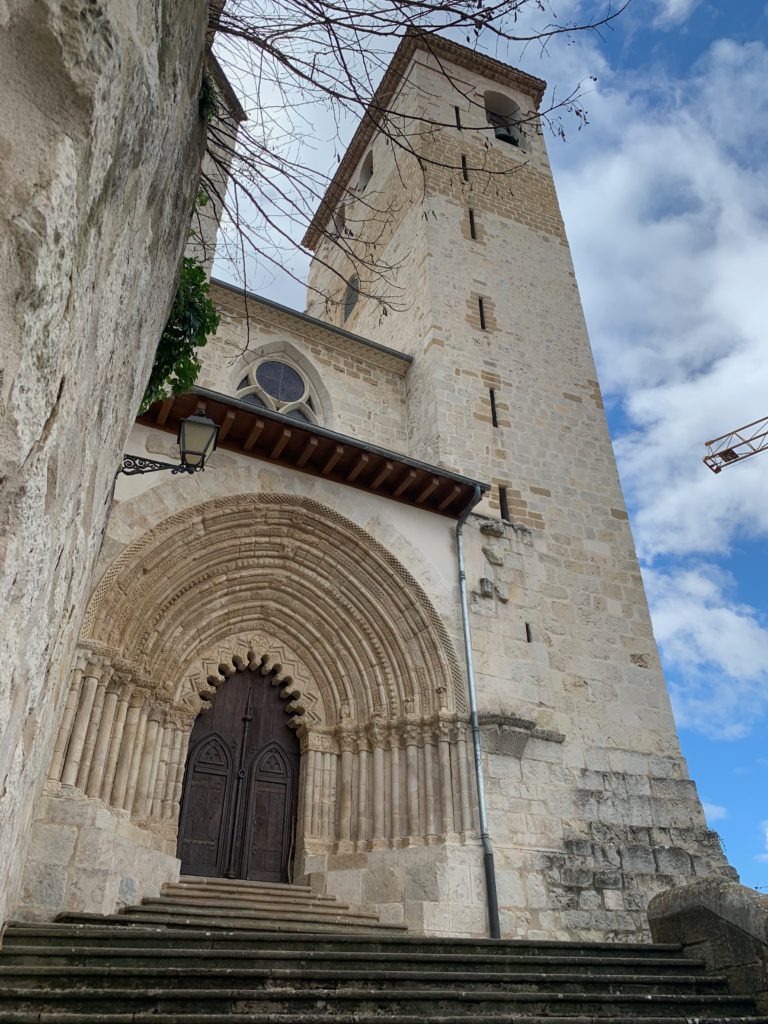
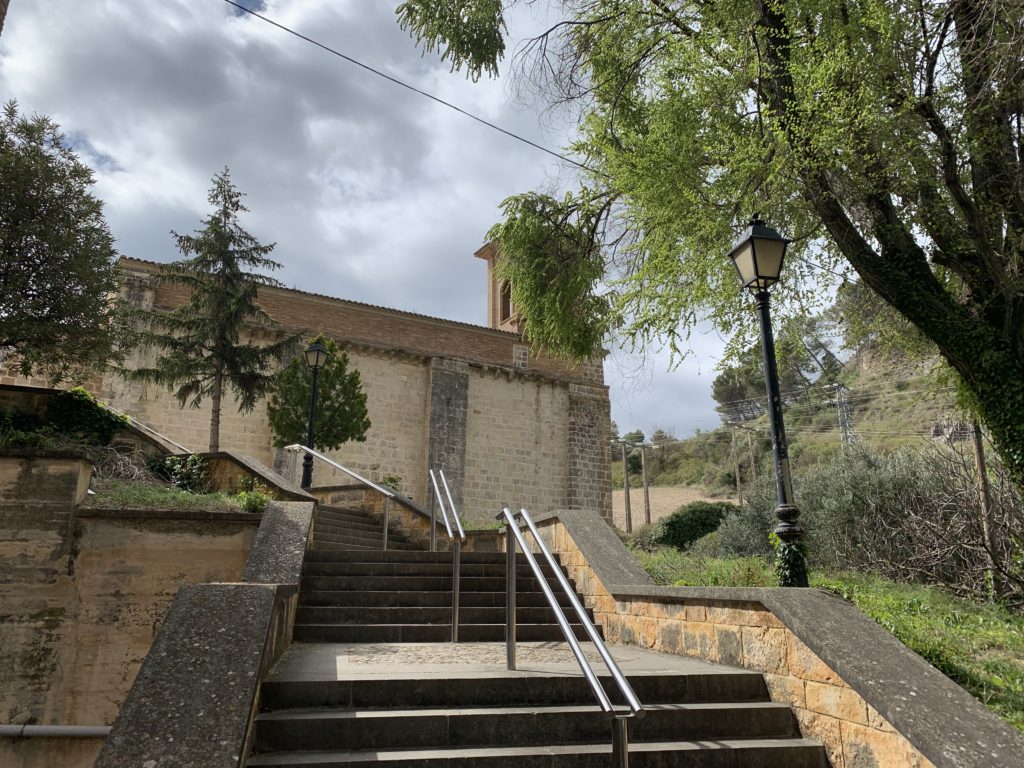
I got a strong sense of that medieval city, especially on the side of the river where my albergue was, right on the pilgrimage road, underneath the old Jewish quarter, pressed up against the hill. In the photo above, the Camino is the street that runs behind those two cars. The ground floors of many of the buildings that run along it are very old, even medieval, as you can see from the two behind those cars. To the right is the palace of the Navarrese kings, whose first floor dates to the late twelfth century, a rare example of civic Romanesque architecture. More on that soon. In the background to the right, the tall tower you can see belongs to the church of San Pedro de la Rua. Above it, on the hill, was one of the castles I mentioned, and when it was destroyed by the Castilians in 1572 in their war against Navarre, it fell on the twelfth-century cloister of the church, destroying half of it. I wasn’t able to get into the church or cloister (hello, Spain, and churches that are not open when they say they will be) but I did use some of my strength to climb the many steps up to the facade. It was worth it.
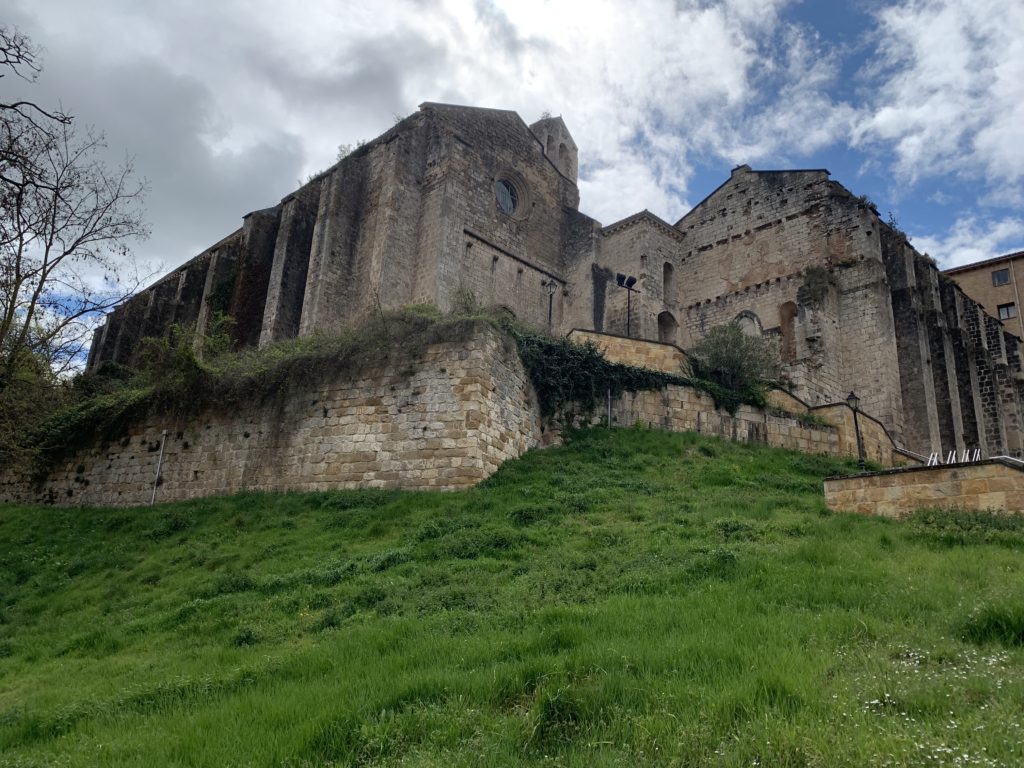
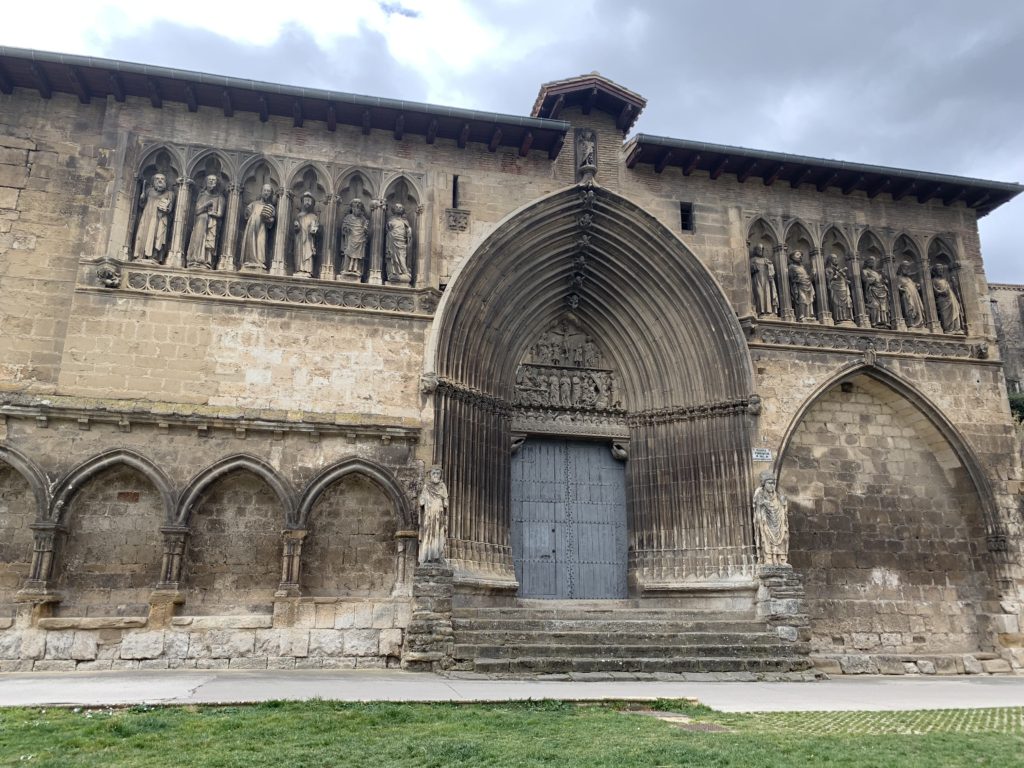
You can see it is as much fortress as church. Estella has been on one frontier or another during most of its existence, most recently in the nineteenth century, during the Carlist Wars.
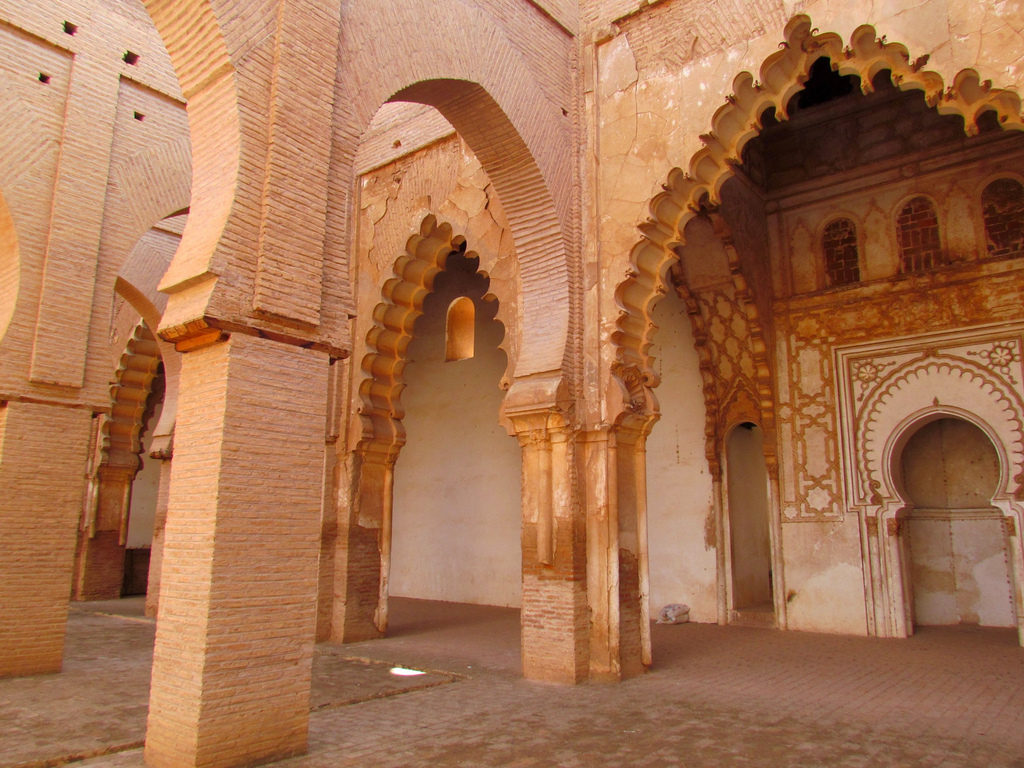
I think when most of us look at a building like this, we think things like “Gothic” “French” “European”. Maybe that polylobed arch gives some of us pause. Pilgrims will have seen one very like it walking through Cirauqui earlier that day, but others might think more of buildings that look like this:
This is the Tin Mal mosque, in Morocco, built to commemorate the Almohad leader Ibn Tumart in 1156, four years before Notre Dame was started in Paris and a few decades before San Pedro de la Rua was constructed. The Almohad Empire extended from Africa through the southern half of Spain at this time.
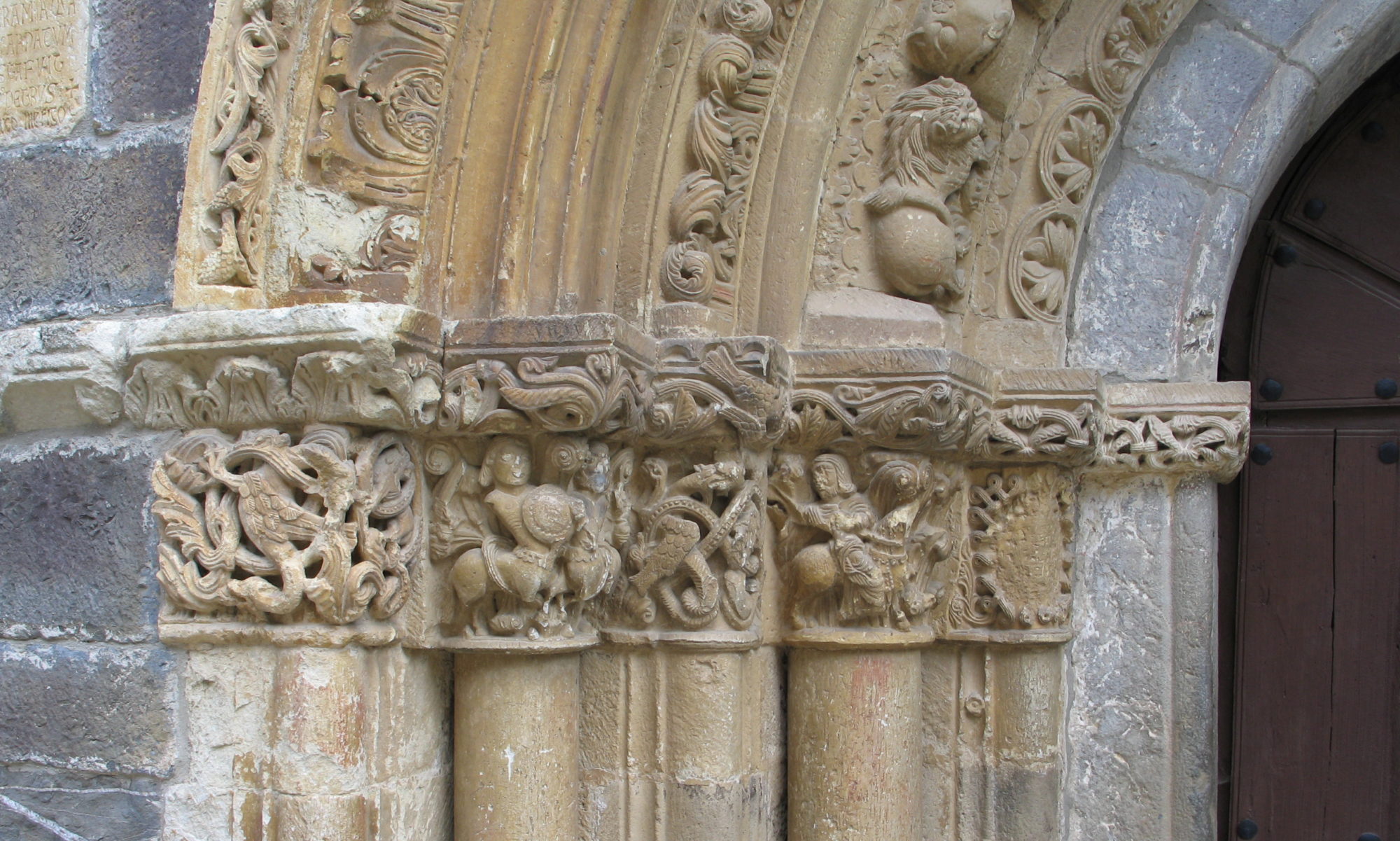
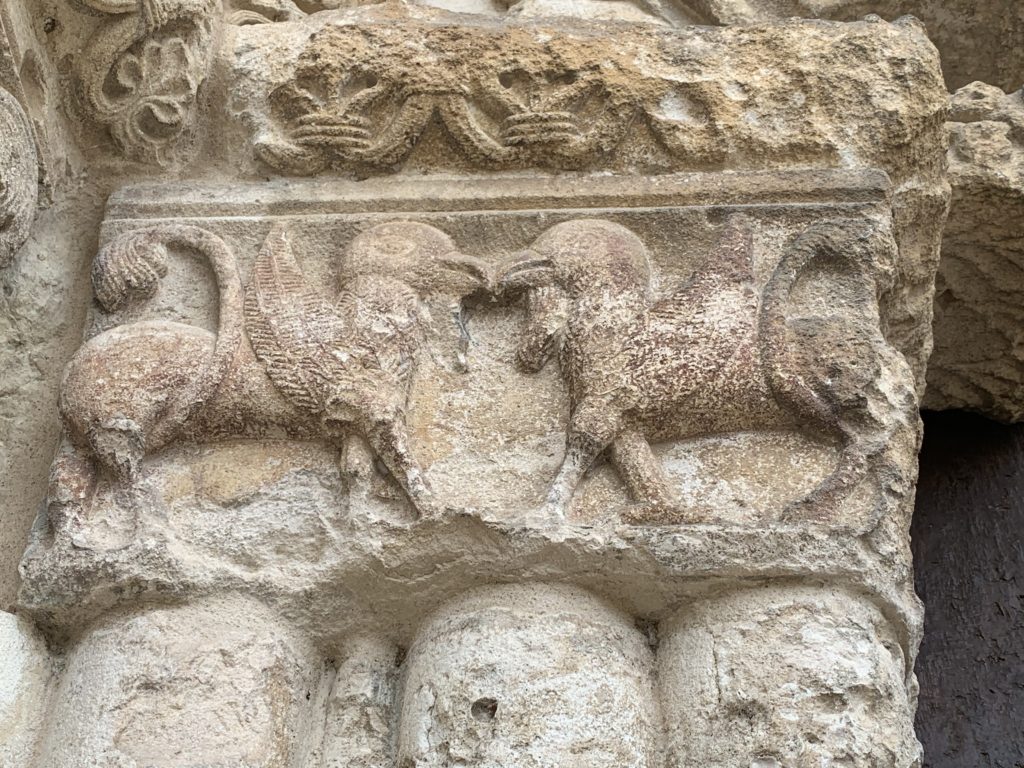
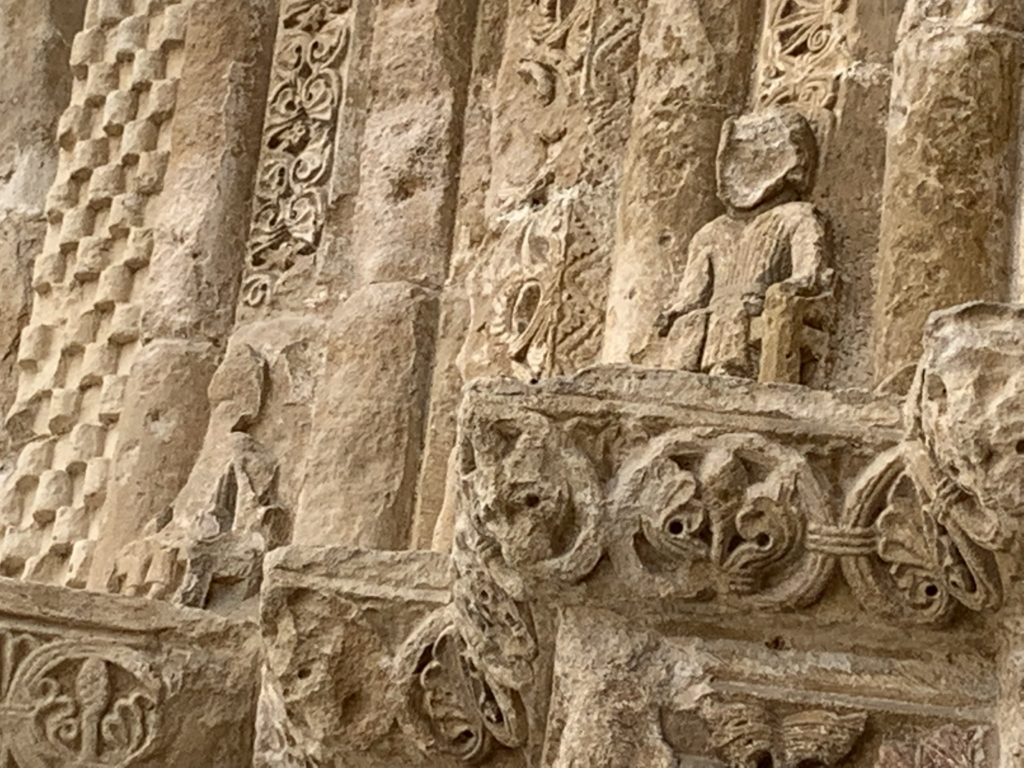
Look closer at some of the figures on the portal, like these two facing griffins. See the detail still preserved on their wings, and what looks like maybe traces of paint.
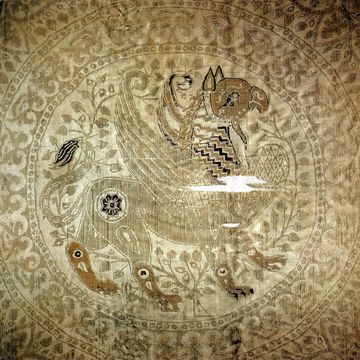
Compare it to this silk roundel originally wrapped around the relics of Saint Siviard and now in the treasury of Sens.
Imagine what it would have looked like if the portal had all been painted. Not the somewhat austere, stern, pure stone we see today but a riot of colour, more like a series of silk textile borders. I also like the little stone guys on thrones. I’ve never seen that before.
It’s not a church, but the Romanesque palace has some interesting sculpture too.
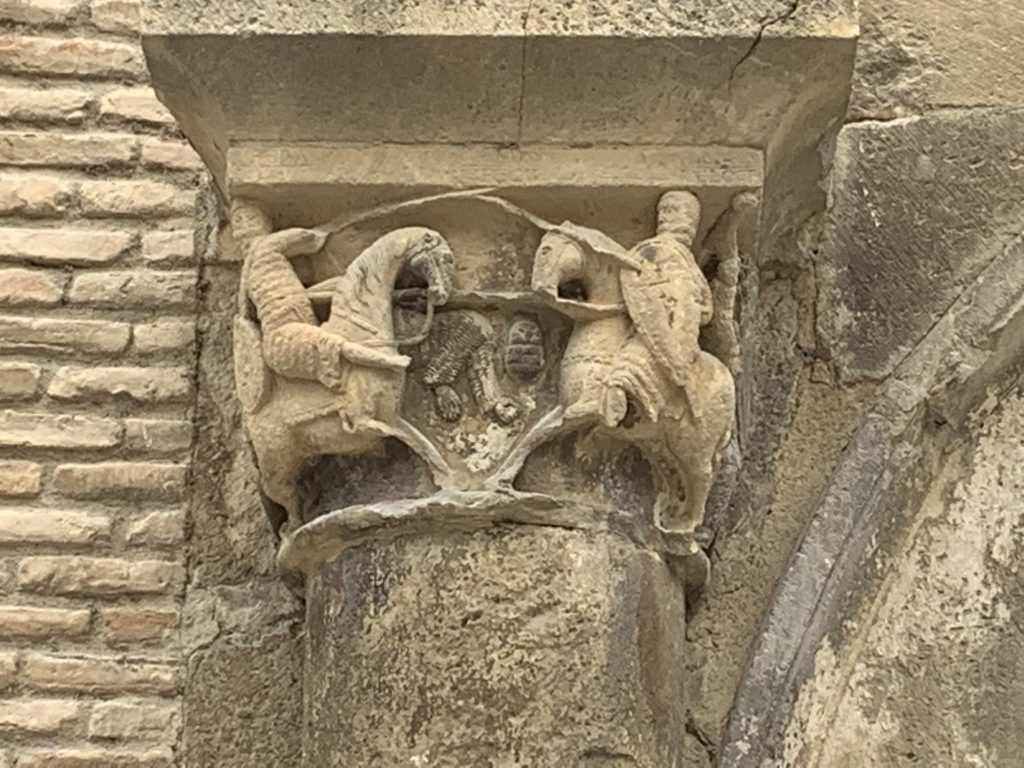
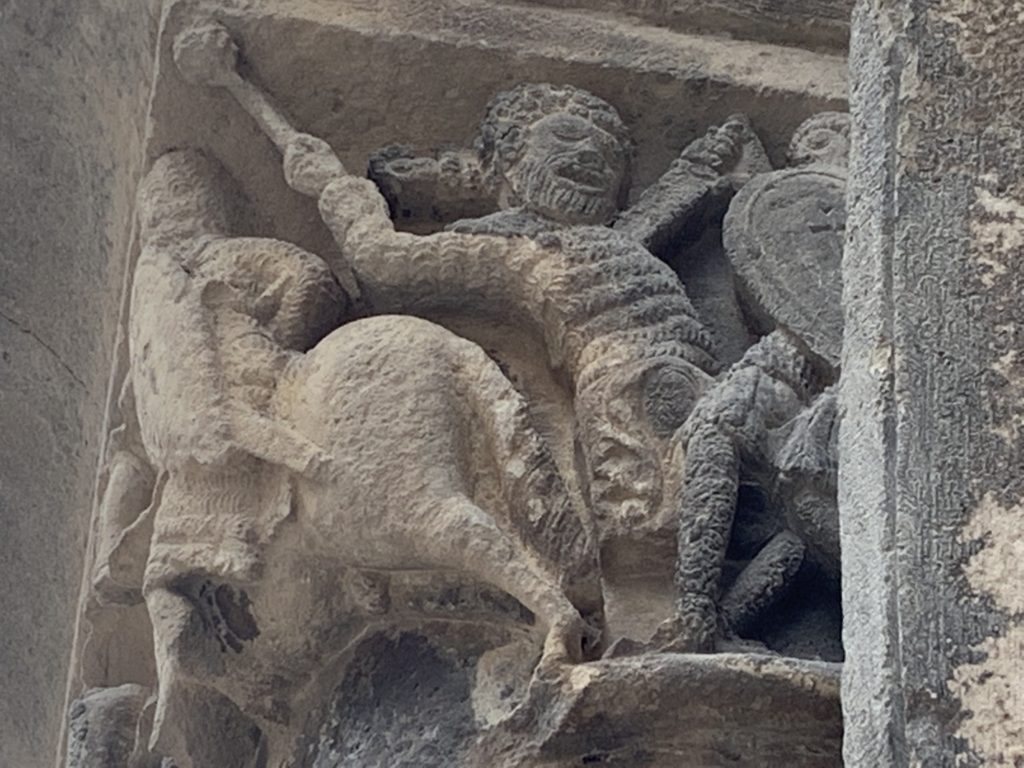
This capital shows Roland fighting against the giant Ferragut, part of the tale of Charlemagne in Spain found in the Pseudo-Turpin chronicle. Their battle supposedly took place outside Nájera, a few days further on the pilgrimage road.
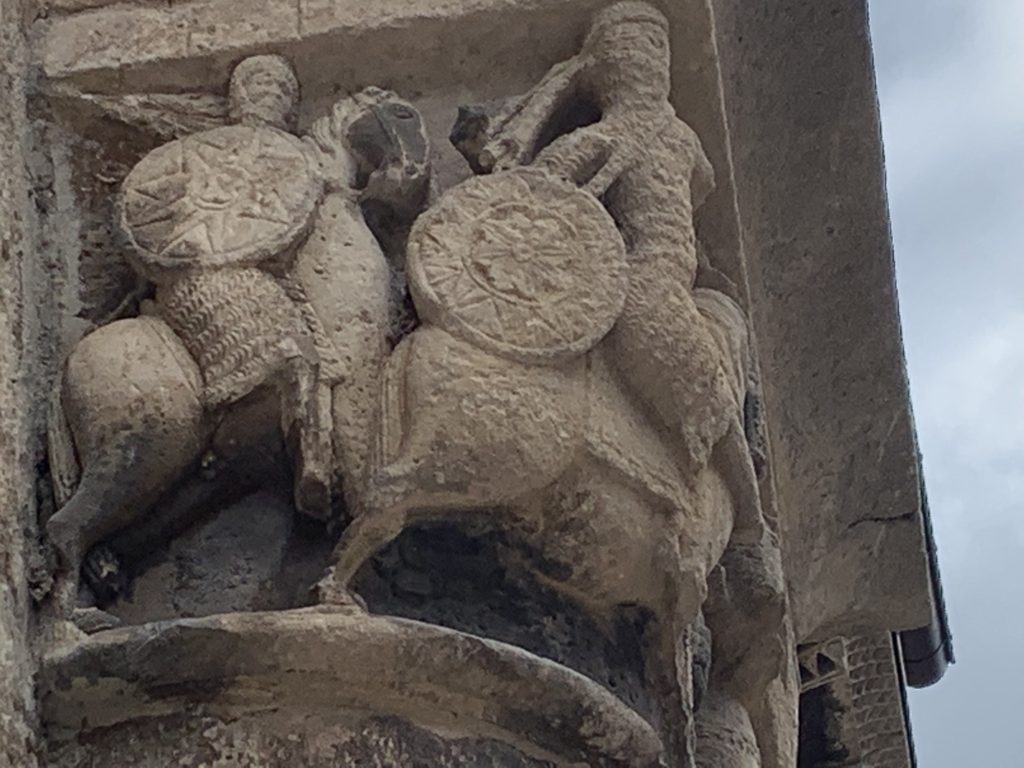
I love the detail you can see here on their shields and their chainmail.
Here is Ferragut himself. Evidently he and Roland paused their fight many times, to discuss the finer points of their theological differences.
But I had other reasons to be interested in Estella. This town, like many others on the pilgrimage road to Compostela, had an important Jewish community throughout the Middle Ages, and when I wrote Pilgrimage, my historical novel about the twelfth-century Camino, I set an important scene among the Jews of Estella. If you have read the novel, it is the moment when Gebirga is travelling with Yusuf, a Mozarabic Christian, and two Jewish traders. They stay with a Jewish family in Estella over Shabbat, much to Gebirga’s discomfort. That evening, their prayers are interrupted by news that their slaughterhouse, down by the river, was on fire. They confront a Christian mob, whose leader tells them a story of seeing a Jew throw a crucifix into the river. At that very moment, he says, the Jewish slaughterhouse caught on fire. When asked who it was he saw, the ringleader points to Yusuf who takes to his heels. Half the mob follows him, and a brawl erupts between the other half and the Jews. It ends in a draw, but Yusuf remains missing.
When I came to Estella, I wanted to see how well what I had invented matched what was there. I based many features of this episode on stories about the Jews of Estella, including a story that the Jewish women of Estella had their own synagogue, and the anti-Semitic legend of the Jew throwing a crucifix in the river. My source for a lot of my knowledge about Jewish communities along the Camino is David Gitlitz and Linda Davidson’s wonderful The Pilgrimage Road to Santiago: The Complete Cultural Handbook
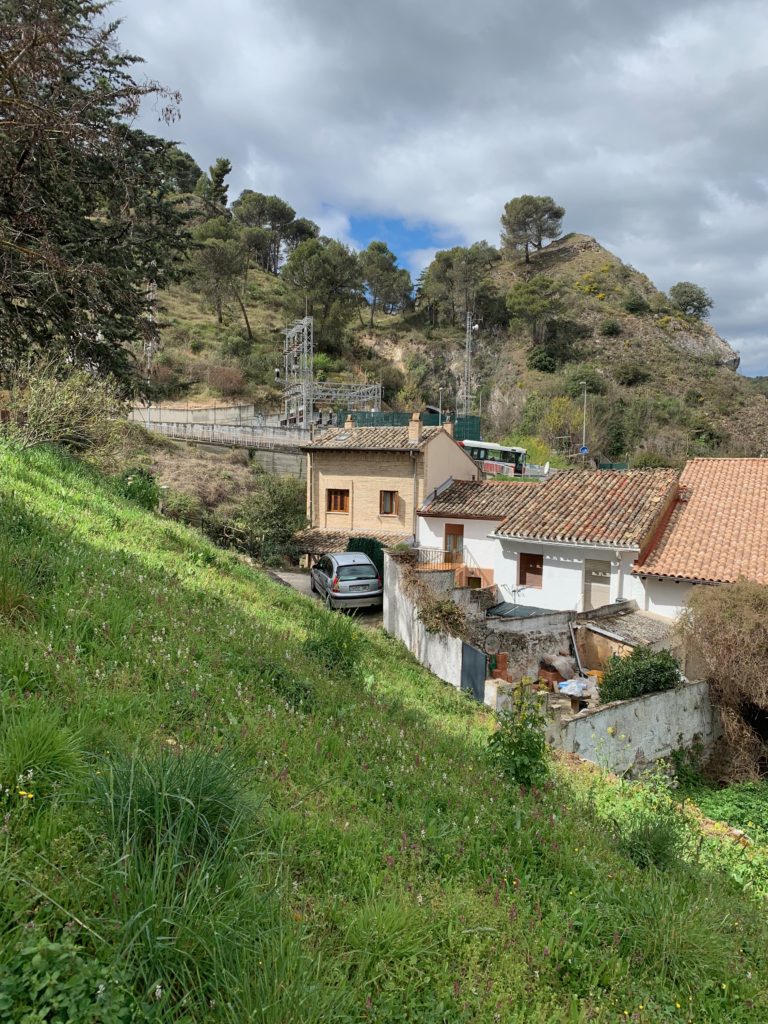
The Jews of Estella were moved around during the four hundred years they lived in Estella, but when Gebirga would have stayed with them, around 1120, their community was on the hillside above the pilgrimage road and the river, up behind the albergue where I was staying. You can see a few house here in the photo, but much of the area is open, and occupied by a bypass highway, just out of sight beyond these houses. Its emptiness makes it easier to remember and imagine the lost community, easier for me than in Toledo or Barcelona.
The church of Santa Maria, here, was built on the site of the synagogue where the men would have prayed in Gebirga’s day. It was taken from by the king and given to the bishop of Pamplona to build this church in 1144.
To the left, and facing where the Jewish community would have been, was this big pile, now an old folks home, but originally a Dominican monastery, built in 1258. Those who study relations between Christians and Jews in Spain know that in the thirteenth century, Dominicans, the “Order of Preachers,” gained the right to be able to force Jews to listen to them preach. In this community, evidently they also taught Arabic. I have read about this and known about it for years; in Estella for the first time I could feel what it would have been like to have this Dominican presence imposed on your community.
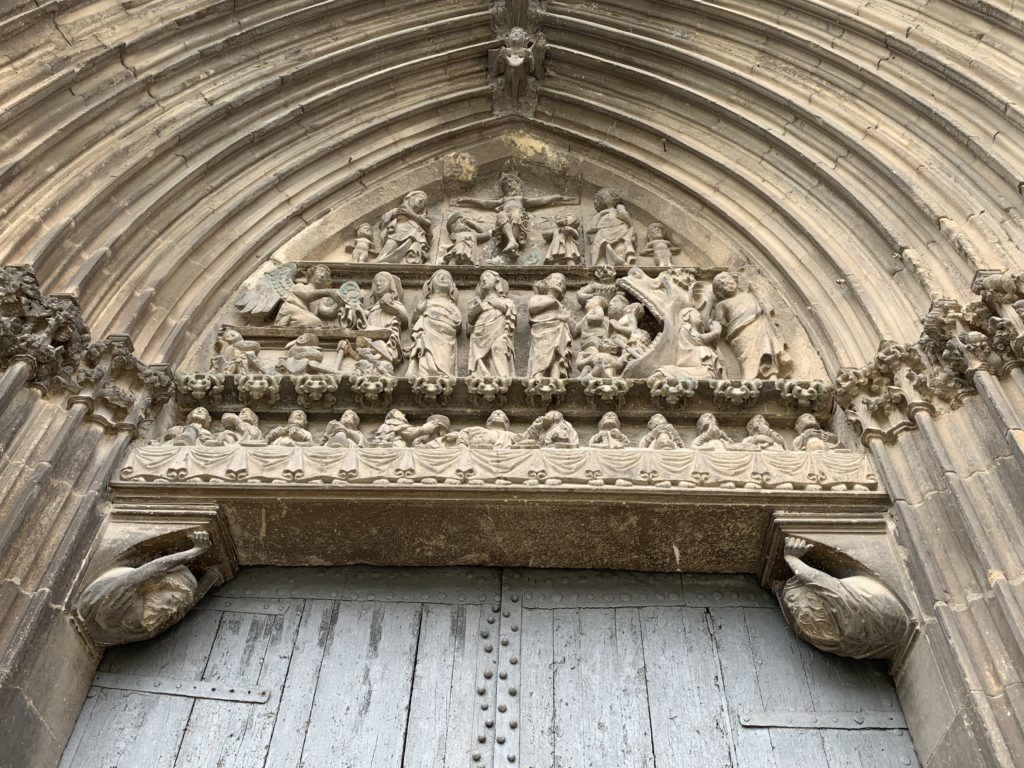
This church has been locked since the late nineteenth century so all you can see is its facade. It sits right on the pilgrimage road into town, opposite the river. It is the church of the Holy Sepulchre, and it was originally built on the site where the Jew was supposed to have thrown the crucifix into the river. This facade dates from the fourteenth century, but as you’ll be able to see, its creators had their minds very firmly on the Jewish community that surrounded it even then.
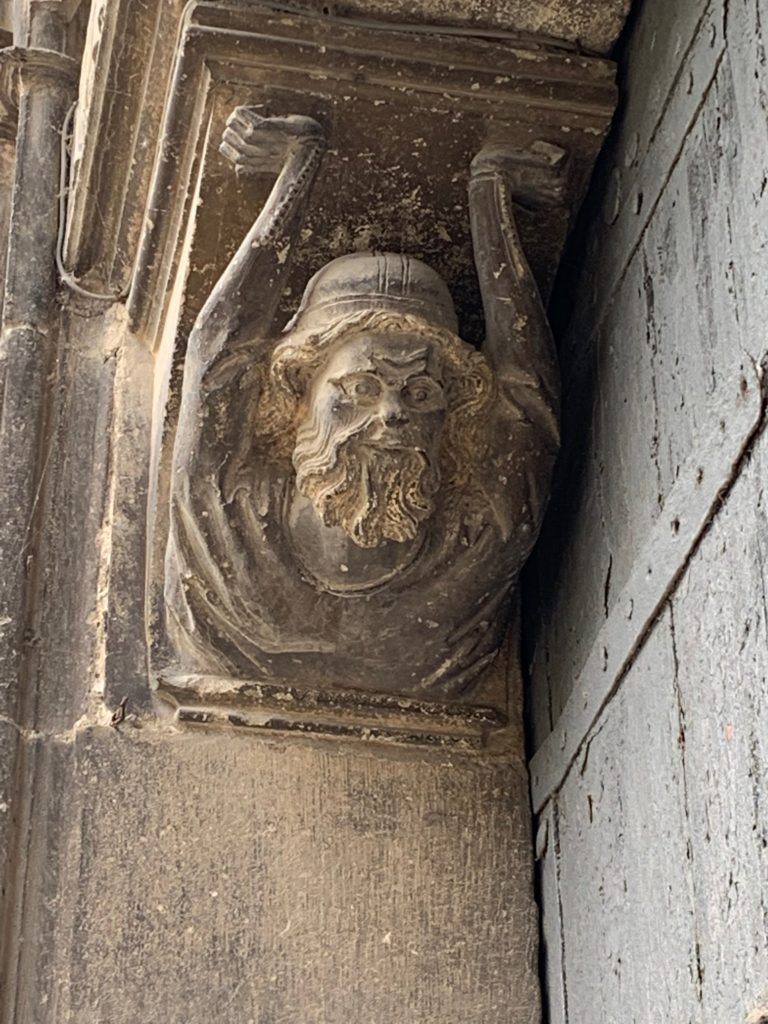
The tympanum at the centre shows scenes from Holy Week — the Last Supper on the bottom; the Crucifixion at the top, the cross flanked by Mary and John; and in the middle, the harrowing of Hell, the women at the tomb, and Christ appearing before Mary Magdalene. But look at the figures holding up the tympanum.
They’re Jews. It’s a disquieting image and there are many ways to interpret the two figures. They hold up the Crucifixion and Resurrection the way what Christians call the Old Testament holds up the New. Perhaps Jewish taxes paid for the church — given the location of the church this would not be surprising. It may not even be an entirely negative depiction. At a time when Jews were increasingly being marginalized in Spain, their physical presence here makes a case for them to have a place, however fraught and marginalized, in Christendom.
Estella has had a troubling and difficult history, only a small part of which I have talked about here. It is also beautiful, only a small part of which I have shown you here.
Today I fly to Pamplona via Madrid and on Monday I begin my first stage on the Camino Francés. I’ll be walking for thirty days, trying to reach Santiago de Compostela, where I will give the Apostle a big hug and then come home.
Why am I doing it? Maybe the real question is, what took me so long? I’m a historian of medieval Spain, but my interest in the Camino has always been more personal than professional. I first learned about it when my mother gave me (I think it was a loan, but I never gave it back, ha ha) Laurie Dennett’s A Hug for the Apostle when I was in graduate school. My doctoral adviser was more bemused by my Camino interests than approving, but when he retired, he have me his copy of Gerogiana Goddard King’s three-volume The Way of Saint James. When I began teaching at Chicago, one of my first classes was on pilgrimage across religious traditions, and I also taught classes on medieval pilgrimage, using Nancy Frey’s wonderful Pilgrim Stories: On and Off the Road to Santiago. I even published a historical novel about the twelfth-century pilgrimage that used the creation of the well-known Pilgrim’s Guide to Compostela as part of its frame.
I think that was part of the problem. I know too much about the history of this pilgrimage to be moved by druids and grails and magical swords. I know all about rites of passage and liminoid phenomena and communitas and what happens when you abandon your old structures and social bonds. Was I going to be the grumpy pilgrim in the corner rolling my eyes when people get a bit new age for my tastes and resisting camino families, angels etc? (Probably) Who wants that? Another reason was that there was so much in Spain that I wanted to visit, and see, and think about. I couldn’t bear the thought of being on the Camino 2km away from somewhere I wanted visit and being too tired to walk there and back. And, well, I’m okay now but I used to get really homesick.
So why now? I finally have the time. It was telling that the first moment I had time to do this, this was the first thing I thought of doing. I have two goals in mind. First is that I want to see if I can do it, if I can walk that far. It will be about 700 km. Second and more important is that I want to see what it feels like to move through this landscape at foot pace. What do I see? What do I learn?
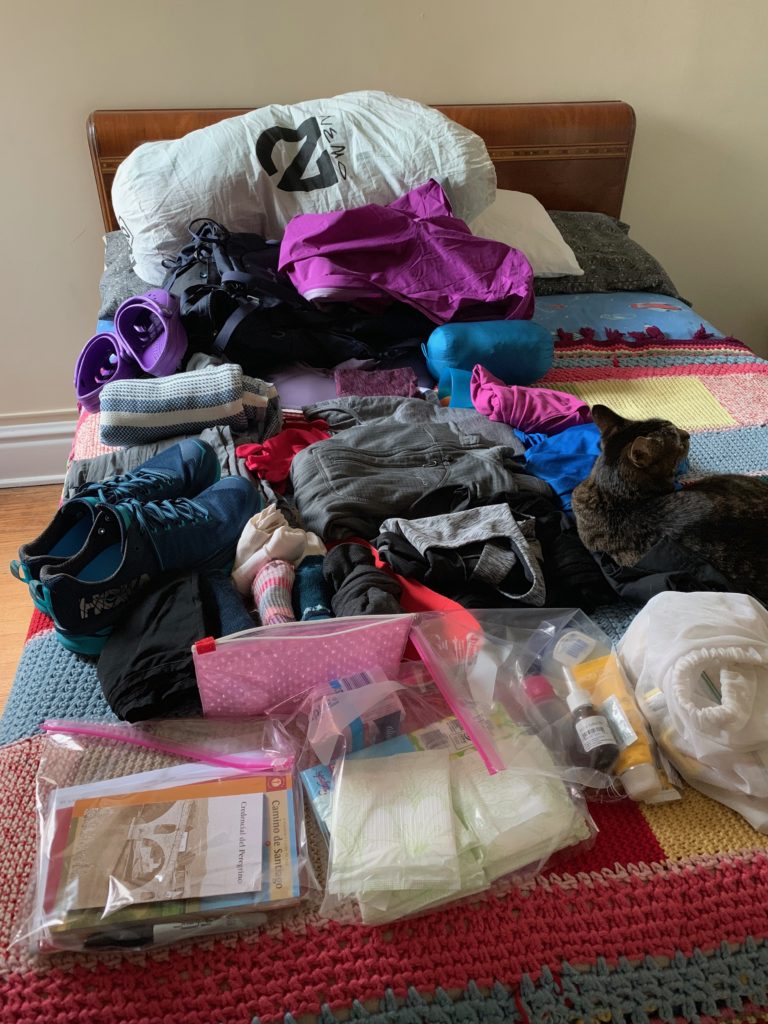
I don’t know if I will keep posting when I am on my journey or if this will be it, but you can follow me on Instagram where I will probably/possibly post some photos at least. or not. How about a couple of photos now? Here’s pretty much everything I plan to bring. (Except the cat. I am not bringing the cat.)
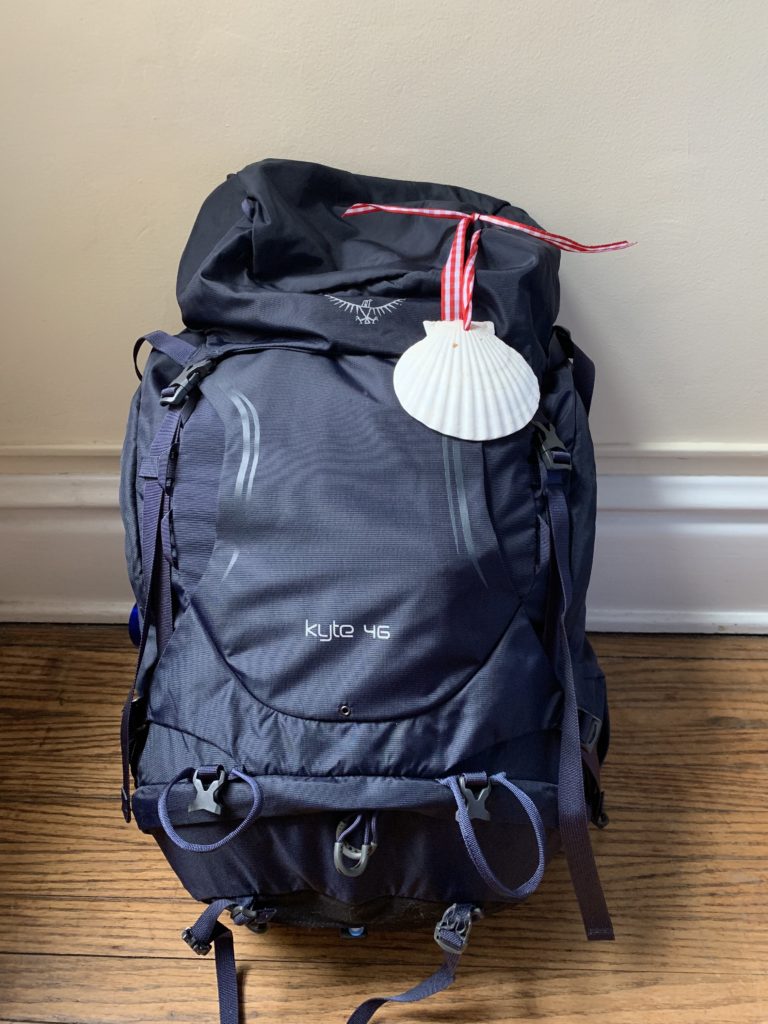
“Yadda Yadda, you’re pack is too big, yadda yadda, you’ve got too much stuff.” La la la I can’t hear you. Here’s the full pack.
The books have been signed, the taxis boarded for O’Hare, but before we all move on to the next adventure, I wanted to write about few of the things I learned and lessons I valued from yesterday’s conference, “Medieval Imaginings: A Celebration of Historical Fiction.” Organized by Barbara Newman as one of the last events sponsored by a Mellon grant that has brought so many exciting ways to think of the Middle Ages, not only to Northwestern University, but to all of us in the Chicago area, the day gathered together students and teachers, historians and literary scholars and writers, as well as a few people who were all of the above.
Cecelia Holland, last but not least, was my favourite part of the day. She read a few passages to us from her 1997 novel about the Templars, Jerusalem, and every time she stopped, I wanted to shout, “No! Keep reading! I have to know what happens next.” But even more than that, she talked about how, when you write about the past, the past must connect to the present. The past is gone; we are here, and it is for us that we are writing. Before she started reading, she spoke about the place she was in when she began the book, about teaching prisoners how to write, about how she loved them and how they were desperate and hardened, hopeless and full of longing, and how writing gave them the chance to be themselves again. We could see those prisoners in the Templars she described, Rannulf and Mouse the rest.
I learned other things too. From a thoughtful discussion of sources and the uses we make of them between Paul Strohm and Bruce Holsinger (whose Invention of Fire we eagerly await), I discovered that I am more fearful of the claims made by historical biography than historical fiction. I know this comes from reading Robertson Davies’s What’s Bred in the Bone as an impressionable youth. Its twin story lines of biographer and subject force us to recognize all that the biographer can never know. I learned that my own initial stirrings of an idea to write a novel about the medieval pilgrimage to Compostela must have begun very close to my reading of Sharan Newman’s novel with the same theme, Strong as Death.
We spent a little too much time talking about Dan Brown. We don’t get upset when someone writes something wrong about the Middle Ages that sinks like a stone; we get upset when it sells a lot of copies and makes a lot of money. My own explanation, not voiced at the conference, for the popularity of The DaVinci Code (and 50 Shades, and Harry Potter) is that they are easy to read, their themes and claims are big, and they satisfy a longing we have for a shared text, now that the Bible no longer fills that space. One question that came up over and over again was whether we are doing the right thing, drawing on the past for the needs of the present, slicing it up and making stories out of it with beginnings, middles, and ends; with character arcs and conflict resolved. What if people read what we write and…believe us? And what if we’re wrong? As we are, as we all are because, remember what Cecelia Holland said: the past is gone. My serious answer to this question is that I would not put my name on any piece of writing I was not prepared to stand behind, with all of its longing, and failure, to hear and convey a voice that is not my own. This is as true of my historical as my fictional writing. My flippant answer (But felt no less strongly. Maybe felt more strongly.) is that, who cares if it is wrong and they believe it? The only problem would be if, “and they believe it,” meant, “and so they stopped telling stories of their own.” Of course it is wrong. I read a history and I tell a history, then you read it and out of that your own history emerges, and together a great chain of stories continues to grow, connecting us and allowing us to share in each other while becoming more thoroughly our selves. Long live stories, and the people with the courage to tell them, and believe them.
I think the writer at the conference may have been the best historian in the room.
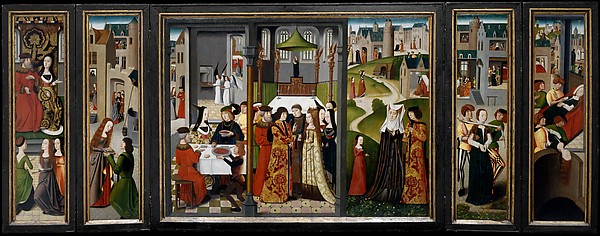
A lot of my readers know that image on the cover of my novel, Pilgrimage, is a detail from a painting at the Metropolitan Museum of Art in New York City, a polyptych (that is to say, a panel painting that folds up) that had once been an altarpiece. The altarpiece as a whole is quite incredible, and shows scenes from the life (and death) of Saint Godeleva; in my novel, the mother of my heroine, Gebirga. The panel even includes images of the blind daughter who inspired Gebirga, so I was delighted to be able to use a part of it for the cover. Here it is in all its glory:
Well, not quite all its glory, as I discovered this evening. As an altarpiece, this polyptych would have hung behind and above the altar of a church. Polyptychs were designed to fold closed during Lent and other times of penance, concealing their beauty from the congregation. The closed doors of the polyptych would often have different painted scenes on their backs. You can see how this works in this link to the Ghent Altarpiece, which shows how it looks both open and closed.
It wasn’t until tonight that I discovered what was on the back of the doors of the Godeleva altarpiece. When closed, the four panels each show a different saint, with kneeling donor portraits in front of the saints on the far left and far right. Here is how it looks:
It was the two saints on the left who immediately caught my eye. I recognized them right away. The bishop in mitre and cope, holding his crook and a book was obviously Saint Nicholas, rescuing the three boys who had been chopped up and put in a barrel. Saint Nicholas, or at least his relics, play an important role in my novel. In their silver reliquary, they are Gebirga’s prized possession, carried with her on her journey until she relinquishes them so they can travel back to the Low Countries from Spain by boat. And as all Dutch children know, every year Saint Nicholas sails again from Spain around this time to reward them with treats. And the saint on the far left? The saint with staff, and pilgrim’s purse and hat, his neck ringed with scallop shells?
That is none other than Saint James, Sint Jaakob, Santiago himself.
An author may think she knows what her book is about, but she only really discovers what it’s about when it moves into the hands of her readers. I have always had the most terrible time distilling my novel into a “pitch” sentence, but thanks to my friend Kyle I can tell you now that it is a book about a girl and a dog who go on an adventure.
And what a dog she is. Her name is Liisa, and after Gebirga, she was the second character to populate my novel. If I were going to send Gebirga out into the world blind, I reasoned, the least thing I could do is give her a dog. Of course, the formal origin of the seeing-eye dog was not until after World War I, when they began training dogs to work with soldiers who has lost their sight during the war. But centuries before that, children’s alphabets had “B is a Blind Man, led by his Dog,” and so I felt it was fair to use a wise dog in my novel. But what kind? The breeds we know now were largely fixed in the last century or so, though many have medieval origins. We know most about medieval hunting dogs, because a good deal was written about them. We also know about medieval lap dogs, and both hunting and lap dogs appear in illuminations. We know rather less about what other kinds of working dogs would have looked like, though we know they existed. Dogs guarded sheep and property long before the Middle Ages, and sheep dogs would have been common in sheep-rich Flanders. So I chose to make Liisa the long-ago ancestor of the Belgian sheep dogs we know today, in the slightly rarer white version. This photograph is a remarkably good likeness of Liisa, considering she lived long before colour photography.
So that is what she looks like, and her instinct to protect Gebirga is built into her bones. I grew up around working dogs. My father and grandfather hunted, and my grandfather always had a dog, a yellow or black Laborador retriever. Remembering the bond between my grandfather and his dogs, like they were one person in two bodies when it came time to work, helped me think of the connection between Gebirga and Liisa. So Liisa is a little bit Nena, a little bit Sally, a little bit Tricky, a little bit Taffy. But mostly Sally.
When I would tell fellow academics I was writing a historical novel about my period, their eyes would widen and the questions and comments would come, always friendly and supportive, maybe a little wistful:
–Really?
–Is it hard?
–I could never do that; I don’t have enough imagination.
–How do you find the time?
(Answer: you make the time)
Reading historical fiction as a child (Rosemary Sutcliff, Jean Plaidy, Georgette Heyer…) was a huge part of why I became interested in history, so the link between historical writing and fiction was there from the beginning. Now my friend David Perry (another medieval historian who pushes his own writing beyond the confines of the academy) has written a thoughtful essay on fiction and scholarship that discusses my novel, Pilgrimage and Bruce Holsinger’s A Burnable Book:
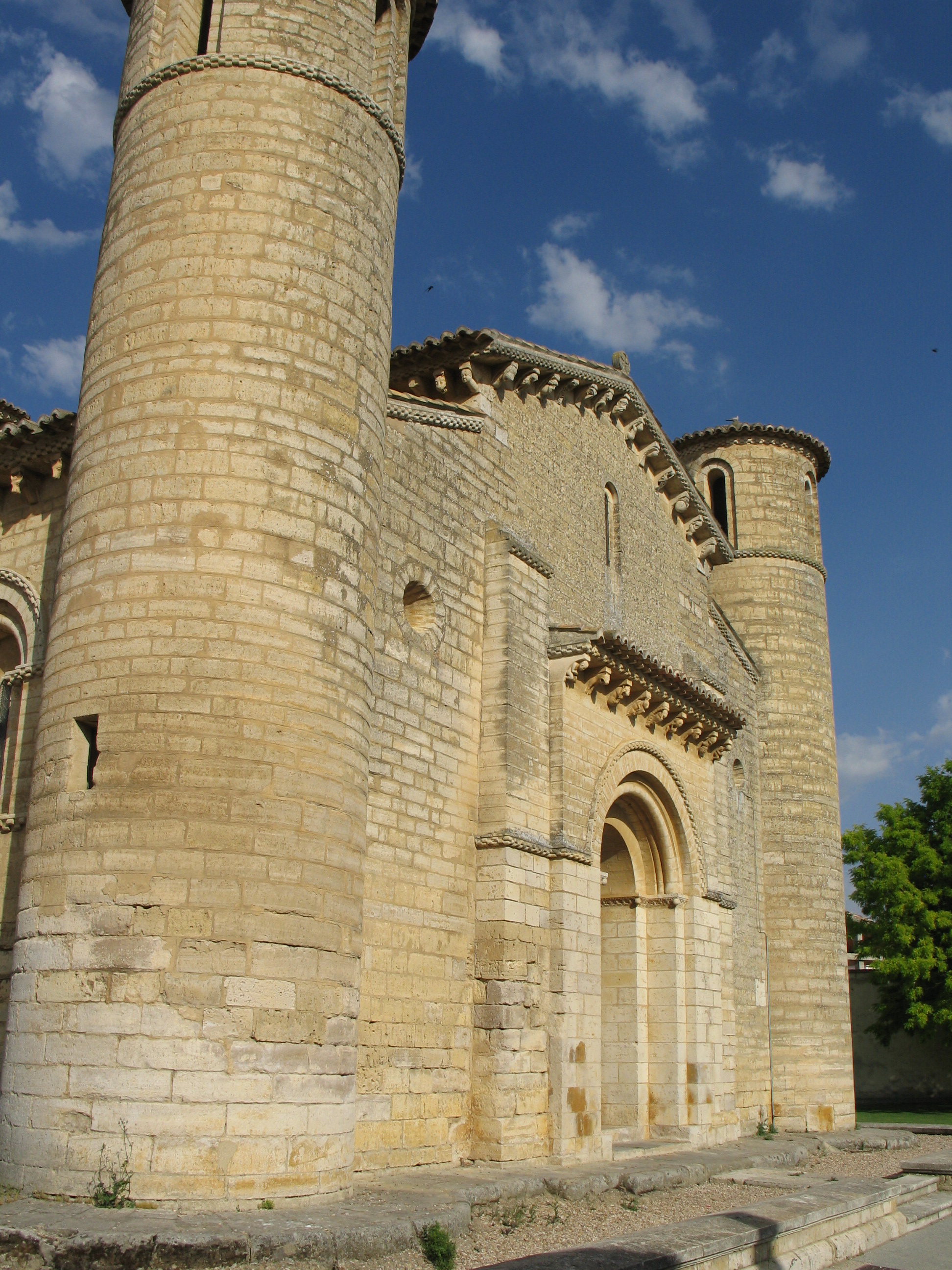
Fromista I thought a word about the sources in English that I used for my historical novel, PILGRIMAGE might be interesting both for readers, and also for modern pilgrims who have tackled (or dream of tackling) the Camino to Santiago de Compostela. One of the wonders of the Camino Frances is not only that it is such an old track, but that there has been so much written about it over the centuries. I think knowing something of the history that created the road only enhances the journey. And it is not a history primarily of dates and politics, but one of art and architecture and real people with hopes and dreams and fears tracking off into the unknown (to them) world. My own heroine takes a roundabout route before joining the road through France via Arles and Toulouse. She takes the Camino Aragones before joining — after a few plot-required detours — the Camino Frances.
The first source pilgrims who are interested in the history and origins of the route usually encounter is the engaging and wonderful twelfth-century Pilgrim’s Guide to Compostela. I link to the Italica Press translation by William Melczer, which is also available in a Kindle edition, for those pilgrims who would like to carry it en route. I would not suggest you replace your modern guidebook with it, however. Let’s just say that Aimery Picaud was a little optimistic when he described the length of each stage…
The Miracles of St. James accompanies the Pilgrim’s Guide in manuscripts, and is now available in its own translation. The gem of this book is its translation of the medieval sermon “Veneranda dies.” If you want an idea of how they thought of the Camino in the twelfth-century, and the origin of traditions (and complaints) that are still relevant today, this is the place to look. Exerienced pilgrims will discover many differences, of course, but I think you will be surprised to see how the more things change, the more they stay the same.
If your primary interest in the Camino is its art and architecture, and if you want to know more about what you might see along all the main roads in France and Spain, you might like Pilgrim’s Guide to Santiago de Compostela: A Gazeteer by Paula Gerson and Annie Shaver-Crandell. I found it an invaluable resource for imagining my heroine’s journey.
A resources designed more for the modern pilgrim, because it describes what you will see stage by stage, is David Gitlitz and Mary-Jane Davidson’s The Pilgrimage Road to Santiago: The Complete Cultural Handbook. It doesn’t provide trail directions or the addresses of albergues but it is an excellent source for explaining what it is you will actually see on the road and what it all means. I returned to it over and over again while writing.
Julianne Douglas has written a wonderful review of PILGRIMAGE on her blog, “Writing the Renaissance.” I say “wonderful” not only because it is positive, but even more because I think she really captures in her review what this novel is about and what I was trying to do. I can fairly say that if this review appeals to you, you will probably like the novel. You can check it out here:
And do keep Julianne’s blog bookmarked. It is a great place to catch up on the latest historical fiction. Julianne performs a real service to the HF reading community with her thoughtful reviews and interviews. I have been turned on to a lot of great novels I would not have known about otherwise on its pages. But more than that, it is a place for Julianne to explore her own writing interests in Renaissance France. Recent posts have been on John D. Rockefeller (yes, UChicago people, that Rockefeller) and the excavations at Fontainebleau; the illuminations in Claude de France’s prayer book; and a gorgeous nineteenth-century stained glass image of Renaissance poet, Louise Labé.
And check Julianne’s blog again tomorrow, when she will be interviewing me about the novel